Paper-writing guide, part 1: why write a research paper at all?
Before your first paper, learn why scientists publish, how journals replaced letters, how peer review works, what each section of a paper does and which article type suits you.
Most students writing their first research paper hit the same wall. The results are in, one way or another, but turning them into a paper raises questions no one has answered yet. Where do I start? What belongs in it? What shape should it take?
This first part of CRI's seven-part paper-writing guide steps back to a more basic question: why papers exist at all. It traces how journals grew out of letters between scientists, how peer review and editors decide what gets published, and what each section of a paper is for. Writing a first paper is not just a matter of good prose. It also means deciding how to put what you found on the record for everyone else.
Why write a paper?
A paper is more than something to hand in for a college application or an evaluation. The deeper reason to write one is to spread scientific knowledge. A new result does not travel on its own. However meaningful an experiment is, if it never appears in a paper, no one else can learn from it, and the research community never gets to share it.
A paper also matters for a researcher's career. Publishing strong results in a good journal shows that the work has been judged fairly by a community of experts. For graduate students, researchers and professors, papers are an official record of achievement and often decide which opportunities come next.
The most important reason, though, is that science runs on sharing. One person discovers something, and others repeat the experiment, refine it, challenge it or extend it. Science is never the work of one person, and the paper is the tool that keeps that exchange going.
From letters to journals
The research paper as we know it has not always existed. Before the 17th century, a scientist had two main ways to share findings:
Write a book. After years on one subject, a scholar gathered it all into a single volume. Printing was slow and costly, so producing and circulating a book took enormous time and resources, and new knowledge reached the public only after a long delay.
Write a letter. The alternative was to send findings to a trusted colleague. Isaac Newton, for one, wrote to friends about the books he was reading and the ideas they sparked.
Letters had obvious limits. Only a few people could take part, so knowledge stayed locked inside small circles. And because nothing was checked in public, plenty of wrong information circulated as well.
The scientific journal emerged to fix these problems. In the mid-to-late 1600s, formal publications for recording and sharing knowledge began to appear, led by England and France. In France, journals centered on religion and law came first. In England, the Royal Society of London launched Philosophical Transactions in 1665, the world's first scientific journal.
From then on, scientists shared their work through journals instead of letters, and with journals came the tradition of peer review, in which other experts examine and evaluate a study. Knowledge now spread in the open, where anyone could read it and anyone could check it.
How scientific publishing grew
Those first journals were more than a new format. They laid the groundwork for making science public knowledge, and academic publishing has been the main way researchers communicate ever since.
Nature, Science and the top tier
The best-known journals today are Nature, based in the UK, and Science, in the US. They carry some of the most influential papers in the world, and a single paper in either can change a researcher's career. Very few papers get in: review is demanding, and publication can take several months to more than a year. That selectivity is why these journals have become a symbol of trust, a home for thoroughly vetted results.
Open access
Traditional journals mostly run on paid subscriptions, so reading a paper means buying it or having an institutional license, which critics say keeps knowledge locked inside certain institutions. The open access movement grew out of that concern, and its core idea is simple: science should belong to everyone.
The best-known open access journals are the PLOS (Public Library of Science) series. Authors pay a fee to publish, and in return anyone in the world can read and download the paper for free. More and more researchers now treat open access publishing as a natural choice.
Measuring a journal's influence
With so many journals, it can be hard to tell which ones matter most. The standard yardstick is the Impact Factor: how often, on average, the papers a journal published over the previous two years have been cited. The higher the number, the more widely the journal is read and cited.
A high Impact Factor is no promise that every paper in the journal is excellent, and attention is increasingly shifting from the journal to the individual researcher or paper. Measures such as the h-index capture both how much an author has published and how often that work is cited.
Peer review: how papers are judged
A published paper has been tested by other experts before it reaches the world, which makes it a product of shared scrutiny rather than one person's writing. The system behind that scrutiny is peer review, and a typical paper passes through six steps:
Writing. The researcher writes up the experimental results or theoretical analysis.
Choosing a journal. The author picks a journal that fits the topic and the level of the work, and submits to that journal only. Sending the same paper to several journals at once breaches research ethics.
The editor's first screening. The editor checks the basics: Is the format right? Does the topic fit the journal? Quite a few papers are rejected here.
Assigning reviewers. Two or three experts in the field are chosen to read and evaluate the paper, usually anonymously.
The decision. The editor weighs the reviewers' opinions and chooses an outcome:
Accept: published without changes
Minor or major revision: revised, then reviewed again
Reject: not published
Revision and resubmission. If changes are requested, the author revises the paper in response to the reviewers' feedback and resubmits it. Most papers go through one or two rounds of revision before the final decision.
Published results become a foundation for the whole scientific community, so something has to stop careless or unverified claims from spreading. That is peer review's job. Reviewers ask:
Does the logic have any flaws?
Does the experimental design hold up?
How does the work connect to earlier research?
Is anything overstated or misinterpreted?
Review is usually blind, so that reviewers can judge the work on its merits without personal feelings or conflicts of interest getting in the way. Some journals use other models. In double-blind review, authors and reviewers are hidden from each other; in open review, both sides are named.
All of this means that getting a single paper into print takes far more collaboration and verification than the writing alone.
Who are the editors?
Once you submit, the first person to read and judge your paper is the journal's editor. Editors do far more than administration: they decide which reviewers see which papers, and whether a paper is published at all. They come in two main kinds.
Academic editors are professors and active researchers who edit alongside their own work. Their expertise runs deep and they know the latest trends. But editing is not their main job, so they may be short of time for it, and critics note that their choice of reviewers can lean toward their own networks and interests.
Professional editors work full time at journals such as Nature, Cell and Science. Most hold a PhD in a related field, and their job is to evaluate and edit papers rather than to do research. The model has three advantages:
they focus only on editing, so decisions come faster and more consistently
they maintain well-organized networks of reviewers
they are relatively free of conflicts of interest with authors and reviewers
In practice, many journals mix the two: academic editors handle papers in particular fields while a full-time staff runs the core of the journal.
Because the editor is your paper's first gate, build the paper with the editor's view in mind: a clear cover letter, sentences that sum up your work, and a topic stated plainly from the start.
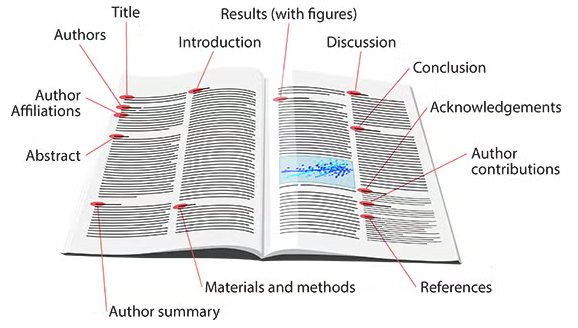
The parts of a paper, from title to references
A paper is not just a record of what you did. It follows a format shared by scientists around the world, a kind of official language of research. Each part has a set purpose, and once you understand the structure, papers become much easier to read and to write.
Section
What it does
Title
Sums up the topic briefly and clearly. Searches and citations start here, so it should carry the key terms.
Authors and affiliations
Lists the people who did the research and their institutions. The first author is the one who led the research and writing; the last author is often the head of the lab, the principal investigator (PI).
Abstract
Summarizes the whole paper, usually in 150 to 250 words. Most journals make it free to read, so the key points must come through.
Introduction
Explains why the study was done, briefly covers background and earlier research, and states the aim.
Materials and methods
Describes exactly how the experiments or analyses were carried out, in enough detail for another researcher to repeat them.
Results and discussion
Presents the findings with graphs and tables and interprets them, comparing them with earlier studies and with what was expected. Some journals split this into two sections.
Conclusion
Briefly sums up the results, their significance, limitations and future directions, and restates the message you want readers to remember.
Acknowledgments
Thanks funders, people who helped with the work and contributors who are not authors.
Conflict of interest
Discloses any financial or personal interests that could affect the results, a key safeguard for credibility.
References
Lists every source cited, in the style the journal requires, such as APA, MLA or Nature style.
The main parts of a published research paper, labeled
None of these sections is a formality. Together they form a blueprint that lets research be shared openly and followed by others, and on a first paper, simply sorting your thinking into this structure can make the flow of your writing much clearer.
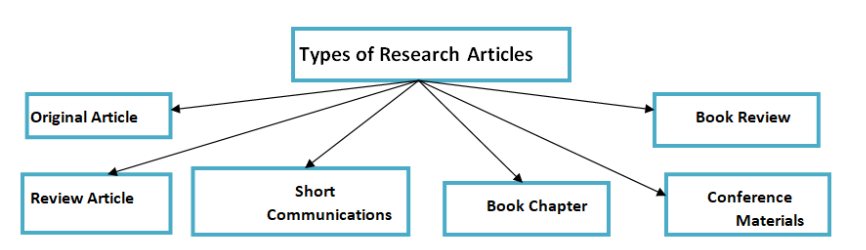
Types of papers: not every paper reports new data
Students new to research often ask, "Aren't all papers basically the same?" In fact, papers take several forms depending on their purpose, and for a high school or college student, choosing the one that fits the research is an important first decision.
Review articles
A review article summarizes and organizes existing research instead of reporting new experimental results. It:
maps out the research done on a topic so far
analyzes each study's contributions and limitations, and the trends across them, to show where the field stands at a glance
creates something meaningful from a broad literature search, without running experiments yourself
makes good practice for a beginning researcher
Reviews come in several forms, including literature reviews, systematic reviews and meta-analyses, and none of them is easy. A review demands strong synthesis, a sharp sense of what matters and a logical structure, and every source has to be checked for reliability.
Original research articles
An original research article presents your own findings based on new data. It is what most people picture when they hear "research paper": you design the experiment, collect the data, analyze it and draw a new insight from the results. This category splits further by length and structure:
Article: a long, detailed paper that covers the background, methods and interpretation of results in full. Some journals expect 5,000 words or more.
Letter: a short, focused write-up of a high-impact finding, used when there is not much data but the result is worth sharing quickly. Letters are reviewed and published fast, and high-profile journals such as Nature and Science have long used short formats like this to present just the core of highly demanding research.
Original research and review articles are two of several forms of research writing
Which should you choose? For a first paper, a review that analyzes the existing literature can be good practice. If you have experimental results, the next step is to analyze the data and shape it into a structured original research article. The right format helps you present your research more effectively and plan a submission strategy that suits the journal.
A paper is where knowledge begins
Writing a paper means more than writing well. It teaches you how to give knowledge a structure, and it carries the responsibility of sharing your results with the world. A paper is the last stage of a research project, but it is also the door that lets that research become someone else's starting point.
It can look daunting at first, with an unfamiliar format and a publishing system that seems complicated. But once you understand what a paper is for, how it flows and what each part does, the feeling of being lost fades, and paper writing becomes something you can learn.
The complete series
This is the first of seven parts in CRI's paper-writing guide:
Why write a research paper at all? (this part)
Decide what you'll say before you decide how to start
Figures are the face of your paper
Writing results and discussion that work
When and how to write the introduction and abstract
If you would like to try this with research of your own, the Seoul Research Program brings small groups of students together with visiting professors from US and UK universities to carry out a real research project and write it up as a paper in English.