Inside the Seoul Research Program: how small teams spend ten days with a professor
How SRP's ten days unfold: small teams, 30 faculty and 20 TA hours, a week of research design, a week of writing, and a final poster showcase.
The Seoul Research Program (SRP) doesn't begin with "Let's try this." It begins with a harder question: "Could this become a paper?" Ten days later, every team stands beside a research poster, answering questions from professors and guests about a study that started as a loose interest. Here is how the program gets them there.
One question per team
SRP is an in-person summer program in Seoul, taught by professors who travel from US and UK universities such as Harvard, Caltech, MIT, Columbia, UChicago, and Oxford. Courses range from neuroscience and chemistry to climate modeling, economics, law, education, psychology, film, and architecture.
A class takes up to about 10 students, who split into teams of three to five, and each team pursues a single research question. Teams are built around the interests students describe when they apply. The final question is settled in class: students bring rough ideas, and the professor weighs each for value and feasibility and helps set a direction. A student who can't settle on a topic can choose from a few options the professor suggests. From there, the team spends the rest of the ten days on that one problem.
Master's and PhD students from leading universities serve as TAs, helping with background research, experiments, and writing. Between small teams and close guidance from the professor and TAs, first-time researchers learn methods quickly. In one past cohort, a team with no prior research experience completed its study and, on the professor's recommendation, submitted the paper to a journal in its field.
How the program is designed
SRP research is dry-lab work, built from data, published studies, and models rather than wet-lab biology or chemistry experiments. Most projects center on data analysis, literature review, or economic and social modeling. The reasoning is practical. A high school student who spends months in a wet lab rarely generates original biological or chemical data beyond assisting a graduate student, but a well-framed analytical project is one students can control and back up on their own.
A few principles shape everything else:
Interest becomes an academic question. Conversations with the professor turn a vague curiosity into something researchable.
Have a question you want to investigate?
Explore our faculty-guided programs, or tell admissions what you are curious about.
The question gets a paper-scale design. The work follows the logic of an academic study, not an essay or a report.
Faculty give feedback, not answers. The professor acts as an advisor rather than a lecturer: a research partner who follows each team's work, tests its thinking, and pushes the question further.
The output is research, not an activity log. Each student finishes with a paper that shows how they think, which gives the professor clear evidence for evaluating them.
Because professors watch students reason, take feedback, and grow over ten days, a later recommendation letter can rest on direct observation. CRI picks faculty for their mentoring experience and depth of supervision rather than name recognition, and it measures success by whether students can explain their own research process, not only by where they are admitted.
A day at SRP
The program runs for ten class days on a campus in Seoul, and the schedule is tight on purpose. Students spend more than 50 hours with faculty and TAs, more contact time than a typical three-credit university course: about 30 hours of faculty lectures and seminars and about 20 hours of TA sessions and group work. Before the program begins, students join an online pre-meeting, and the first class day opens with an orientation.
Time
Session
What happens
9:00 a.m.–12:00 p.m.
Faculty session
Core concepts in the field, analysis of prior research, research methods, and discussion that sets each team's direction
1:00–3:00 p.m.
TA session
Hands-on work: literature searches, data collection, methodology design, and structuring the paper
Late afternoon and evening
Team time
Teams meet on their own to push the project forward, with faculty and TAs checking in with feedback
Every class is face to face, so a session can shift with the questions students raise and how well they are following, instead of delivering fixed content one way. CRI considers that in-person exchange the most important part of teaching research.
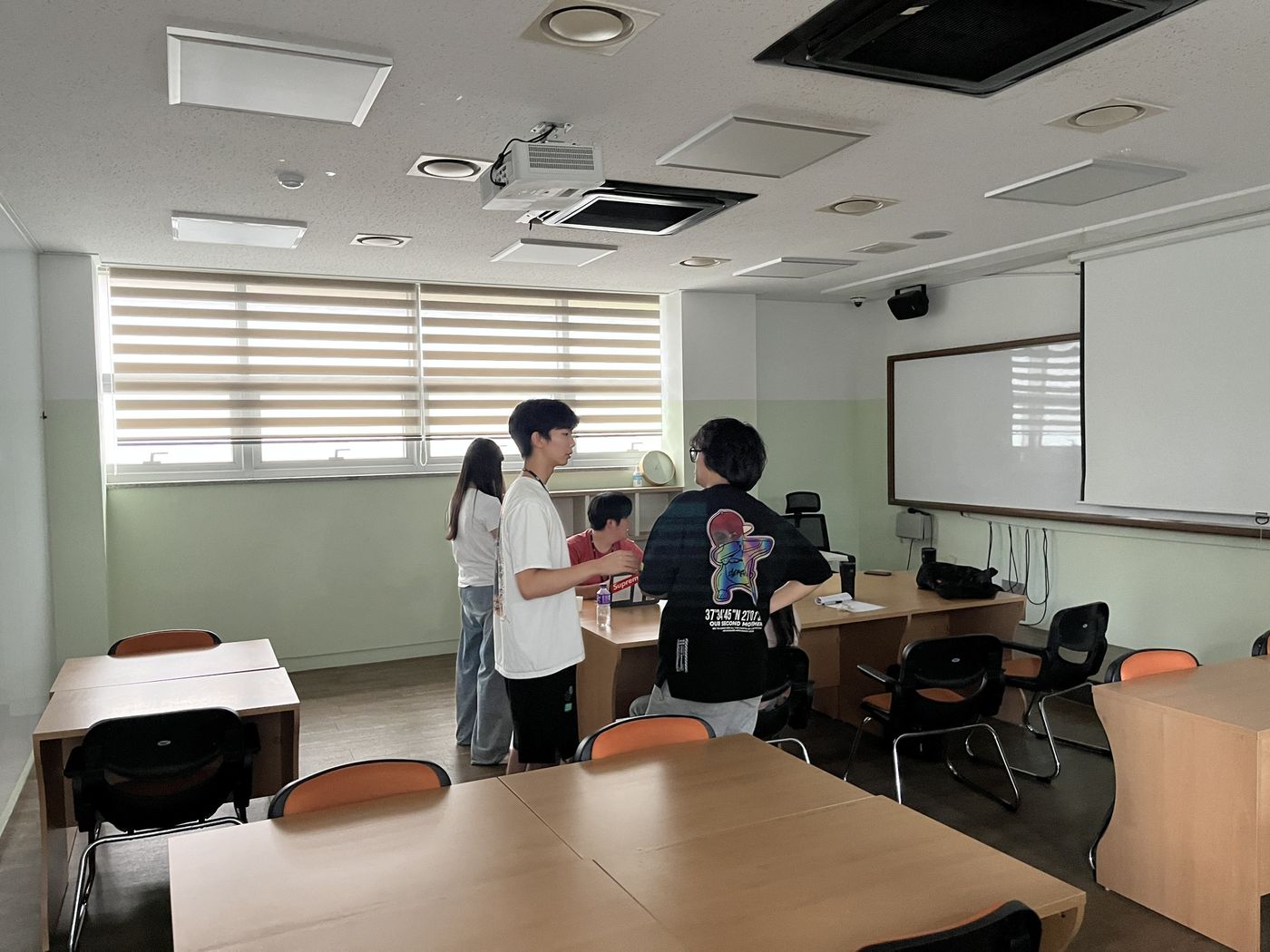
A team at work in an SRP classroom
One day off, usually on the weekend after the first week, gives students time to rest or catch up, with no classes or official activities.
Week one: foundations and research design
The first five days build the background a topic needs and the plan for studying it. Professors teach core concepts, theory, and recent research. In a psychology course, that might mean principles of behavioral and cognitive neuroscience and academic perspectives on mental health; in an applied computer engineering course, hands-on basics of sensor technology and biosignal processing. That grounding helps students sharpen their questions.
The research starts right away. On Days 1 and 2, teams brainstorm to choose and narrow a subtopic, then read prior studies to refine a hypothesis or research question, while TAs teach literature searching, reference management, and basic statistics. Teams also design their methods: what data to collect and analyze, and how to structure an experiment or survey. An engineering team might design and test a sensor prototype; a social science team might draft a questionnaire or interview guide.
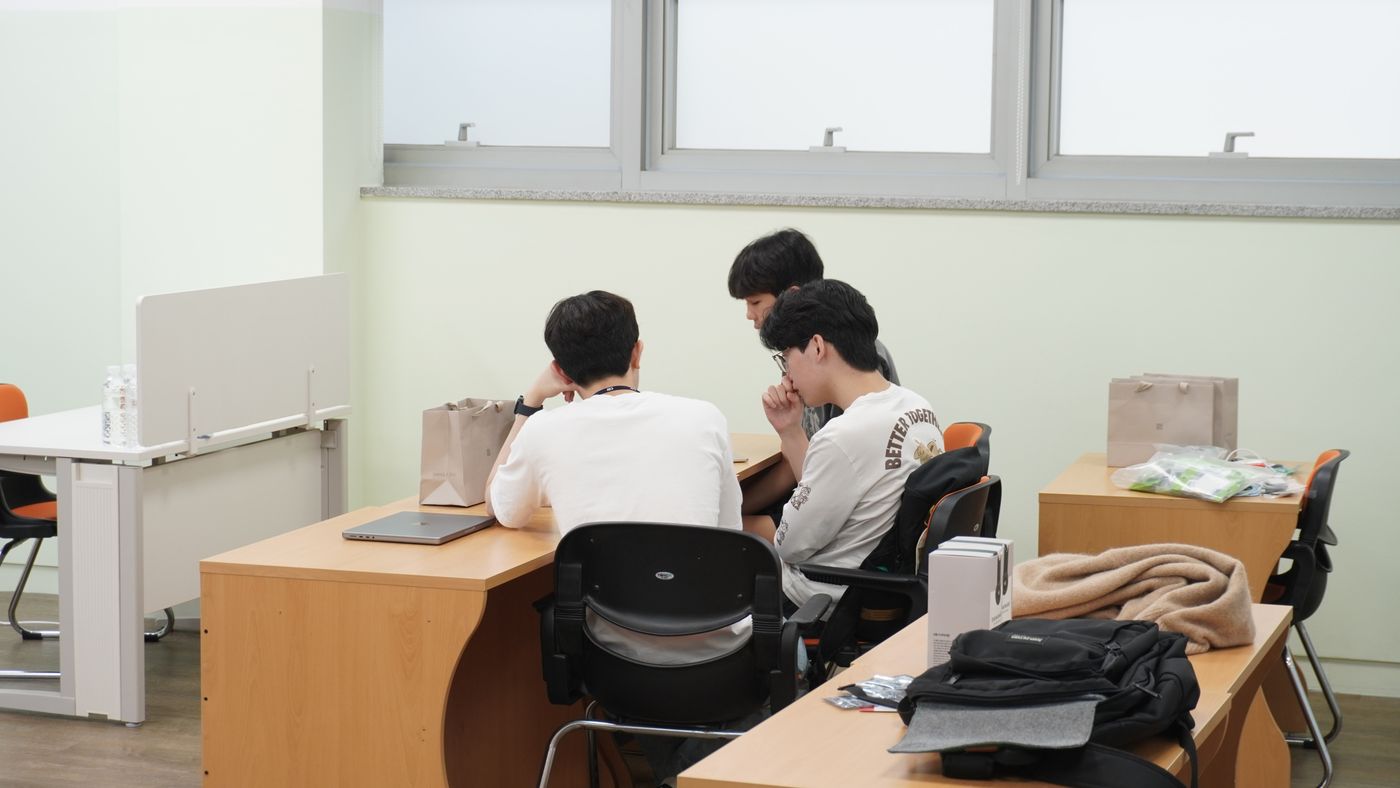
Teammates confer around a laptop at SRP
At the end of the week, each team brings a draft research plan to a checkpoint. The professor reviews the ideas and materials so far and says what to pursue and what to shore up, so the study has a solid frame before writing begins. That weekend, students and faculty get together for a program dinner, where students compare progress and talk with professors about more than coursework.
Week two: from results to a full draft
In the second week, the plan becomes a paper. Teams finish collecting data or run their analyses, then write section by section. Around Days 6 and 7, they analyze early results and focus on the Methods and Results sections. The professor rotates among the teams every day, reviewing drafts and giving feedback on the spot, so each paper improves through daily rounds of revision. TAs cover formatting and citation style, the details first-time authors tend to miss.
Around Day 8, each team completes a full draft and meets one-on-one with the professor to discuss the logic of the argument, the interpretation of results, and the conclusions. Over Days 8 and 9, students tighten the writing and run any further experiments or analyses the feedback calls for, until the final manuscript is done.
The poster showcase
Week two also includes poster design and presentation practice, so students learn to summarize findings visually and present them. Each team distills its paper into a single poster (title, background, methods, results, conclusions and implications) with charts and images. Faculty and TAs advise on what to emphasize and how to lay it out, and rehearsals bring feedback on delivery, timing, and handling likely questions.
The final day is the Research Poster Showcase. Posters go up in a classroom or hall, teams take turns presenting, and students from other teams, professors, and a few invited guests circulate to listen and ask questions. Faculty give their overall feedback, and the program closes by celebrating the finished work. The work doesn't stop there: after the program, CRI supports each manuscript through journal submission.
Who SRP suits, and who it doesn't
SRP is selective, and it isn't for everyone. It tends to suit students who:
have plenty of activities but struggle to explain how they connect to an intended major
attend international schools and want to show deeper engagement with a field than participation-based activities allow
learn better in person than online, and think best by asking questions and debating
are ready to dig into an interest, form their own questions, and explain them in writing and in conversation
value the depth of their thinking over the result itself
want a lasting piece of work to show for the program, not just a short-term experience
It may not be the right fit for students who want a fast, visible credential, who expect an instant answer to "What will I get out of this?", or who want set answers handed to them.
What students take home is a research poster and a paper. In CRI's view, college admissions reward not so much what a student did as how deeply they can explain it, and ten days of SRP work carries naturally into essays, interviews, and recommendation letters. SRP doesn't promise outcomes. What it does is build a research environment designed to lead to them.
Eligibility and selection
SRP is open to students in Grades 9–12 and to first- and second-year college students preparing to transfer. Selection starts with a written application covering academic background and interests, followed by an individual interview. The interview is less a test than a conversation about what a student is curious about and whether they are ready for the research process. Admitted students are notified individually, and professor assignments and preparation follow.
Past SRP projects have ranged from a literature review on the CO₂ absorption limits of amine-based solvent systems to a study of how cognitive biases and heuristics affect consumer behavior. More of that work appears on the Student Success page.
If you have a question you'd like to test against real data and real feedback, the Seoul Research Program page has the current program details and how to apply.