International law clearly exists. So why does it look so powerless at the moments that matter most, in a pandemic or a trade conflict? That question anchored William Burke-White's class in CRI's 2025 Winter Online Research Program, and his four students answered it through two very different global crises.
Burke-White, a professor at the University of Pennsylvania, did not treat international law as a list of provisions and definitions to memorize. His class asked whether the law actually worked when a real crisis or conflict hit, and if it did not, why. The students split into two groups of two, and each group completed one paper. His lectures gave everyone the same grounding in how international law is built and where its limits lie. In TA sessions and in their own research, the two groups took that grounding in completely different directions.
Group 1: the pandemic and the limits of international law
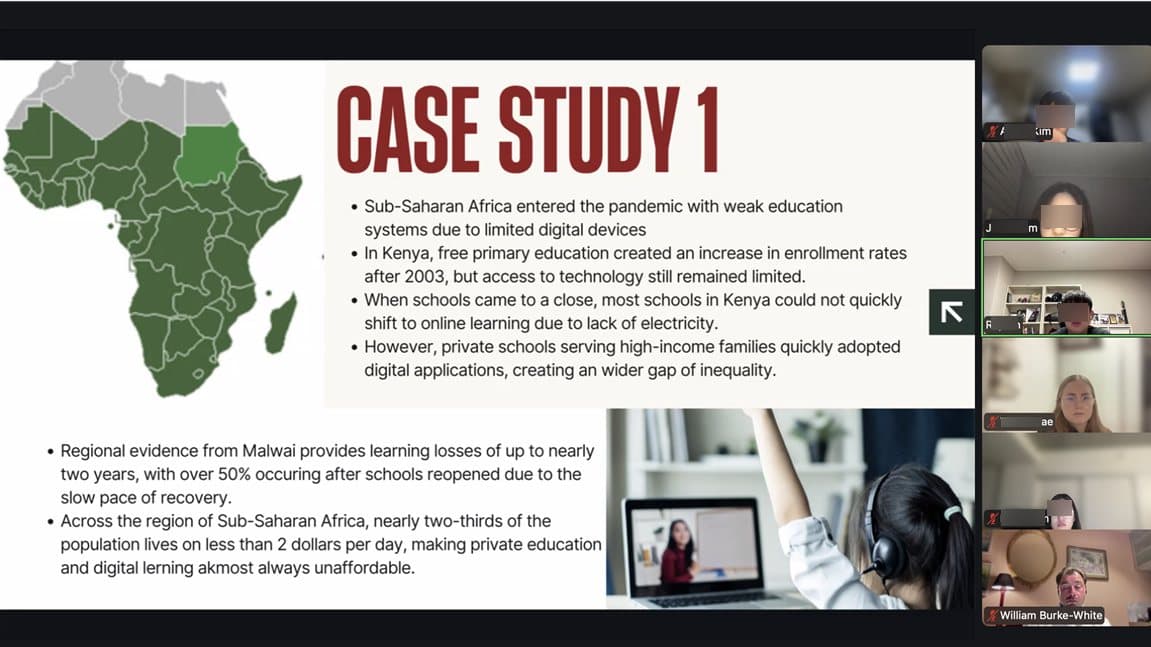
The first group asked why international law failed to guarantee equitable access to vaccines and education during the COVID-19 pandemic. Its central argument is easy to state: the intentions and declarations were there, but the power to enforce them was not. The students examined what international organizations such as the WHO and UNESCO did during the crisis, and why that role was bound to be structurally limited.
Student A: vaccines and COVAX
Student A took on vaccine access, explaining in structural terms why international law falls short in a crisis even when the goal is to share vaccines fairly. The starting point was an idea from Burke-White's lectures: international law is less a system for controlling states by force than a structure for drawing them into cooperation. From there, A analyzed why the WHO and global health norms carried so little practical weight during the pandemic.
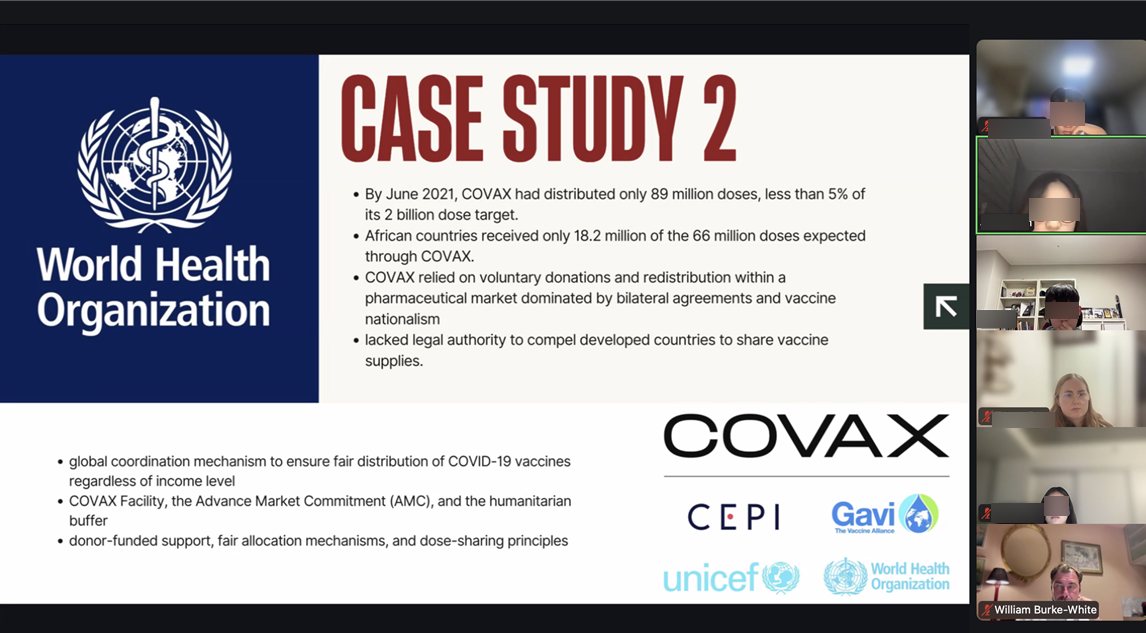
The case at the center was COVAX. It was built to distribute vaccines fairly, but it ran on voluntary participation rather than legal obligation, so it had no real way to restrain the countries that had already secured their doses. Wealthy countries could put themselves first without violating any international norm. The group's slides made the gap concrete: by June 2021, COVAX had distributed 89 million doses, less than 5 percent of its 2 billion-dose target. A's analysis is balanced, presenting the problem less as a "failure" of international law than as a limit built into it.