After finishing a research paper on advertising in the summer of 2025, J. found himself asking a new question: could the thinking he had learned doing research be applied to something he loved, like sports? The answer became a statistics app for amateur basketball leagues, launched first in Korea, and an investor pitch deck built on US market data.
Most students treat a finished paper as the end of the road. In the SRP Extension, CRI's follow-on to the Seoul Research Program, it can be the starting point. There, the startup track led by MIT Sloan's Kit Hickey runs as a ten-week, one-on-one online internship, designed not as another line on a college application but as research-and-execution experience that can carry on into university. J. worked through it with Hickey and startup mentor VA7, turning an idea that grew out of his research into a business plan.
A summer paper on mismatched pairings
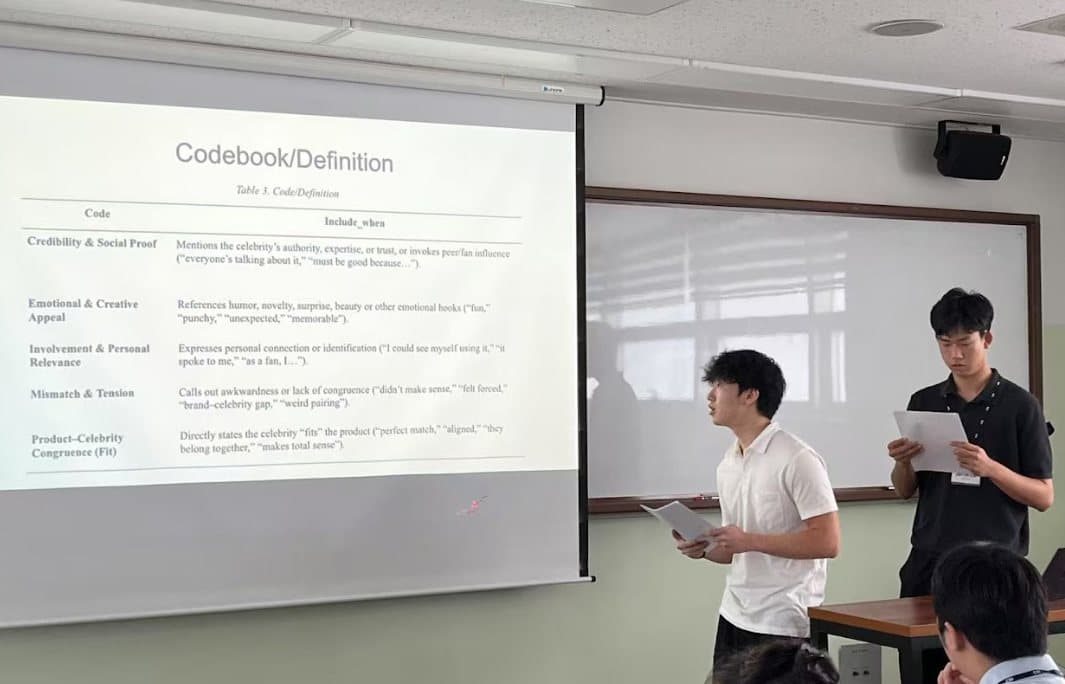
J. started in the 2025 Seoul Research Program, where he completed a paper with Professor Kit Hickey of MIT titled "The Power of Mismatch: How Incongruous Pairings Drive Ad Effectiveness." As the title suggests, the paper looked at how pairings that seem not to fit can make an ad more effective, and it gave him practice in two things he would use again: structured, logical reasoning and data analysis.
It was those skills, more than the advertising topic, that J. carried forward. Applied to sports, a field he loves, they became the basis for his app. After releasing it in Korea, he continued in the Extension with a new goal: taking the product to the US market and setting up a company there.
Two mentors, two roles
The startup track pairs a faculty member with a working entrepreneur, so a student gets both the academic framing and the practical execution. CRI calls this a "research-to-market" model.
Professor Kit Hickey, MIT Sloan
Kit Hickey teaches entrepreneurship at the MIT Sloan School of Management. She is a serial entrepreneur and a former founding member of Draper Athena, and she leads the Extension's Business Plan Studio. Her focus is less on startup theory than on helping students take what they learned in research and translate the problem into the language of the market.