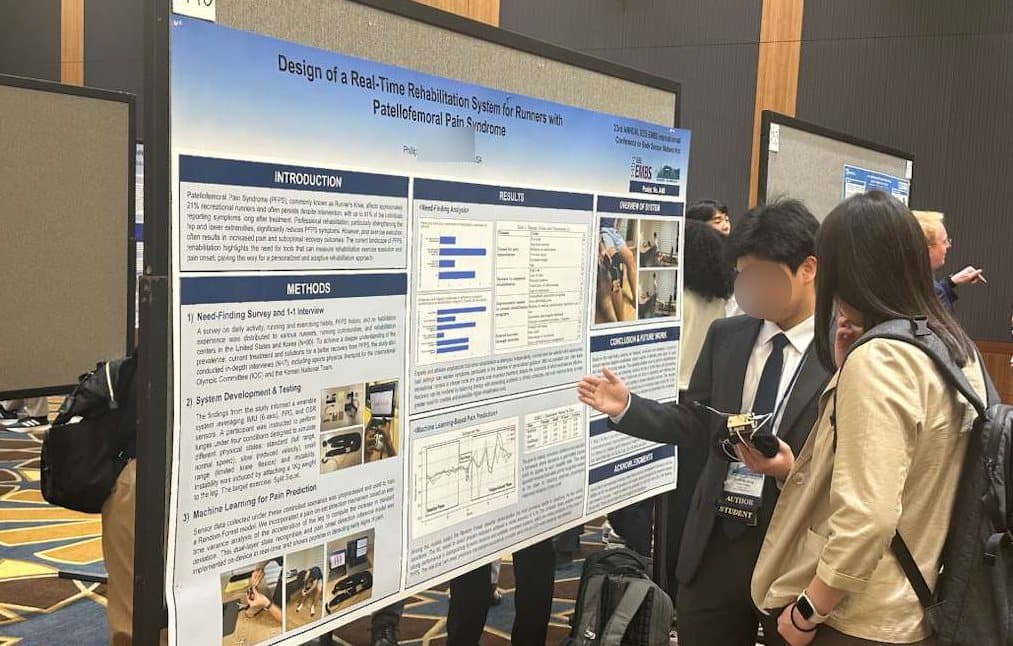
Runner's knee has a way of coming back. Patellofemoral pain syndrome (PFPS) affects about 21 percent of recreational runners and often returns even after treatment, in large part because rehab exercises are easy to do wrong. Jay, a high school student in CRI's 1-on-1 Advanced Research Program, spent summer 2025 chasing a practical question:
"Could I build a smart device that alerts me right before my movement turns unstable during rehab, or right before the pain starts?" — Jay, on the question behind the project
That question became a working wearable, a machine-learning model, and a research poster on a real-time rehabilitation system for runners with PFPS. Jay presented it at IEEE EMBS BSN 2025, the International Conference on Body Sensor Networks. Few high school students reach an international conference with research they carried out on their own, which made this a milestone for Jay and for CRI.
A mentor who studies behavior through sensors
Jay's faculty mentor was Nabil Alshurafa, an associate professor at Northwestern University's Feinberg School of Medicine and McCormick School of Engineering. A leading expert in digital health, he uses wearable sensors and AI to analyze human behavior. He co-directs Northwestern's Center for Behavior and Health, serves as principal investigator on NIH R01 research, and has led many studies on AI-based behavior analysis, stress detection, and monitoring of eating habits.
His research starts from questions buried in smartwatch and sensor data. When do people feel stress? At what moment does a rehab movement start to falter? How can technology change health? Beneath them sits a larger one: can technology help us understand human behavior better, and nudge it in a healthier direction? A project on predicting knee pain during rehab fit squarely inside that agenda, and the overlap is a large part of why Jay's experimental design and analysis could be so careful.
In their meetings, Professor Alshurafa kept returning to the basics: "What does this data mean for a person?" and "What would we actually need to detect for this to help?" That focus is what turned a simple experiment into research worth the attention of working scientists. Jay's poster thanks him and the HABits Lab for their guidance and advice throughout the research design and process.