P. had a 3.77 GPA and an ambitious goal: transferring from a community college into UC Berkeley's Haas School of Business. On grades alone, that was a hard case to make. So he set out to show Haas something a transcript cannot, and he built it from a question about why shoppers so often make irrational choices. The result was an offer of admission to Haas's Undergraduate Business Program (Spieker) as a transfer student for fall 2025.
Looking beyond the transcript
When P. first came to CRI for advice, he was studying at a community college and preparing his transfer applications. A 3.77 is a respectable GPA, but the transfer students Haas admits typically have grades near the top of the scale, and his numbers alone were unlikely to compete.
He began looking for another way to make a convincing academic case for himself, and he settled on research. The interest was already there. Growing up, he had watched his parents run their business and wondered what drove their customers' choices.
A question about irrational buying
P.'s project asked how cognitive biases and heuristics, the mental shortcuts people use to decide quickly, shape consumer behavior. He carried it out in a CRI research program with faculty mentor Andrea Bernini, a behavioral economist at the University of Oxford whose work also covers research methods and who has consulted for the World Bank.
The topic sat squarely within behavioral economics and marketing science, two areas Haas emphasizes, so the link between his research and his intended major, Business Administration, was easy to see.
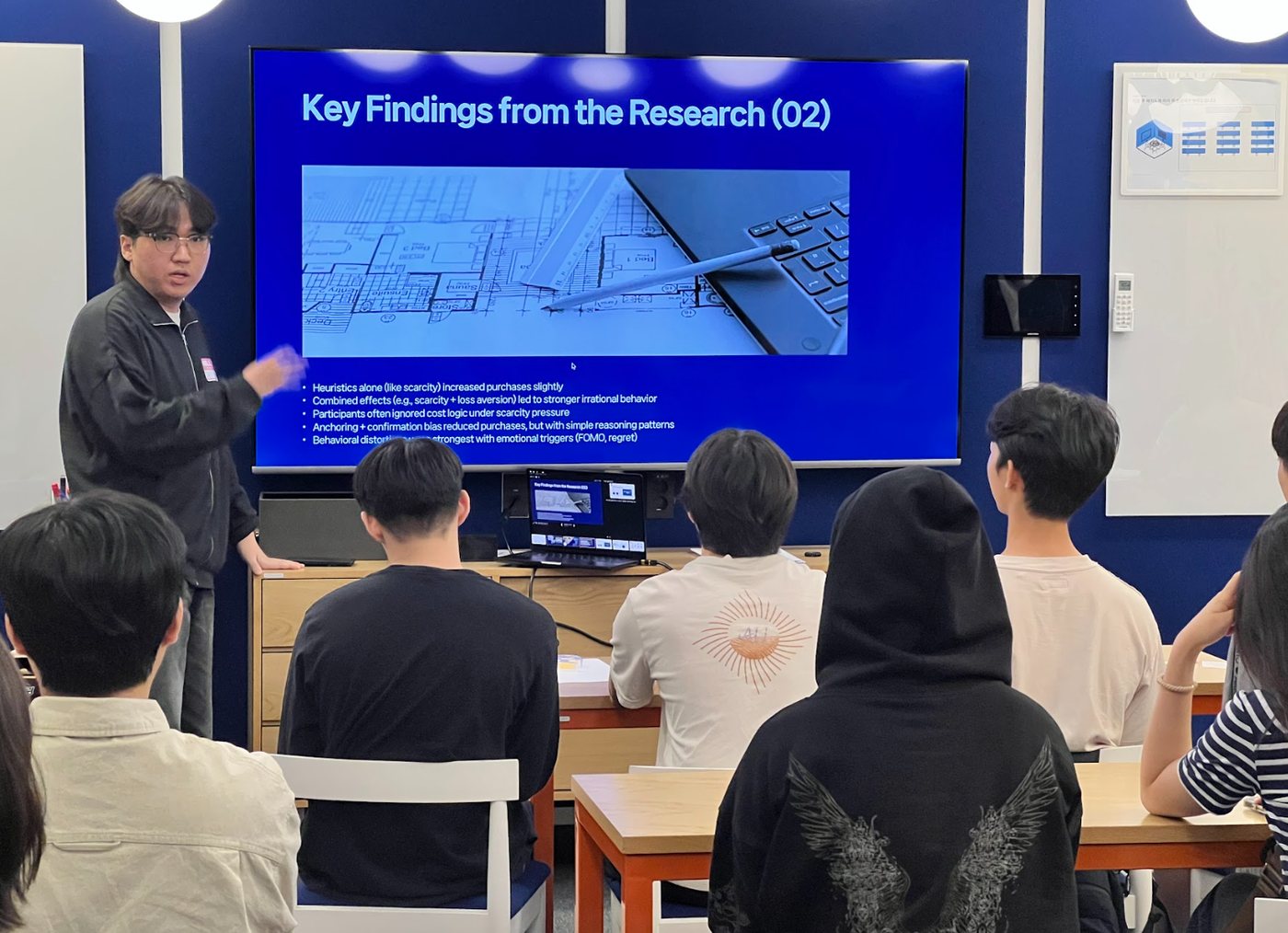
The work became a team paper: P. and two co-authors published "Understanding the Interplay between Cognitive Biases and Heuristics in Consumer Behavior" in January 2025. One of those co-authors, a fellow community-college student, tells her side of the same project on our Student Success page.
Designing the experiment
The project went well beyond summarizing the literature. The team ran the full cycle of empirical research, from experimental design to data collection and statistical analysis, and P. was involved at every stage:
- high school students at international schools and university students in Korea and China