If you look at a person's age, blood glucose, body mass index and lifestyle together, can you tell in advance who is likely to have a stroke? One high school student built an entire research project around that question in CRI's 1-on-1 Advanced Research Program. The student designed the study from scratch, ran the analysis, and saw it through to a published academic paper.
Families often ask CRI two things: what does "doing research" actually involve for a high school student, and can a paper written by a teenager really count as a paper? This project may be the clearest answer to both.
Catching risk before illness
The methods sound technical, but the core idea is simple. Analyze several health and lifestyle factors at once, and a model might pick out the people most likely to have a stroke before it happens. The project belongs to preventive medicine: rather than treating patients once they are ill, it aims to find the risk early enough for a stroke to be prevented.
Putting several models to the test
To test the idea, the student compared several data-analysis methods. The most accurate was a random forest, a machine-learning technique that never decides on the basis of a single criterion. Instead, it weighs many decision rules at once and reaches a conclusion from all of them together.
On the paper's dataset, the random forest correctly identified about 98% of the people who actually had a stroke. In other words, it rarely missed a true case. For a screening tool, missing as few real cases as possible is the priority, so this is a result with genuine medical relevance, not just the output of a computer analysis.
Explaining the why
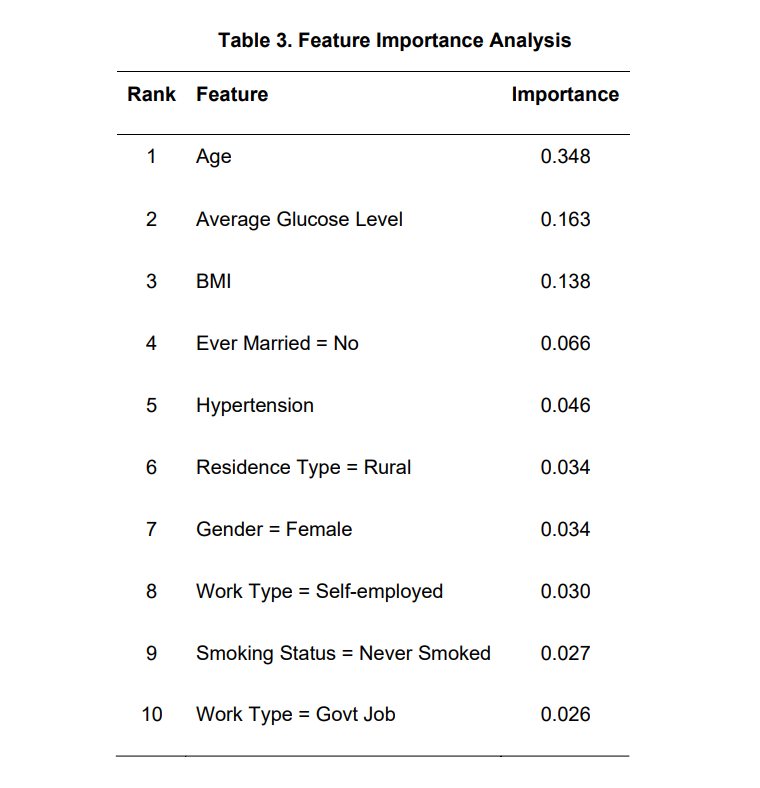
What lifts the paper above a report full of numbers is the explanation that follows them. The student worked through why the model behaved as it did and which variables mattered most. The paper explains, for example, why risk rises with age and why managing blood glucose and body weight matters, tying each point to existing medical research.