Meet the nine TA mentors behind CRI's 2025 faculty teams
From a cryo-EM specialist to an AI startup CEO, meet the TAs who worked with seven CRI faculty teams in 2025 and see how each helps students design, run, and write up their research.
One CRI teaching assistant has operated 200- to 300-kilovolt cryo-electron microscopes. Another has presented research to the UN Security Council. A third co-founded an AI startup and has run AI transformation projects for companies such as Hilton. At CRI, a student's research takes shape under a professor's guidance, but the professor is never the only mentor involved.
That other mentor is the TA. TAs take a professor's expertise and put it into terms a student can work with. They help plan how a project will unfold, then stay with students at every stage, from gathering sources to analysis and writing. Each is a young researcher with real depth in their own field, and for most students, the first research partner they work with day to day. Here are the nine TAs who worked with seven CRI faculty teams in 2025.
Chemistry: Brian Stoltz's team (Caltech)
Stoltz's team works in organic chemistry and biochemistry. Its TA started a PhD at Caltech in fall 2025, arriving with a solid research record in structural biology and biochemistry. At Seoul National University, the TA specialized in cryo-electron microscopy (cryo-EM), handling 200–300 kV instruments with an operator's level of skill. Membrane protein purification, nanodisc assembly, FRET analysis, SAXS experiments: few high school students ever see these techniques, and this TA has carried out every step of them firsthand.
With students, the TA:
Turns an experimental idea into a logically structured plan
Explains why an experiment is needed, not just how to run it
Sets a clear bar for a finished paper: reliable data and interpretation with real depth
Thanks to that support, even demanding topics in organic synthesis and structural biology become ones a student can follow.
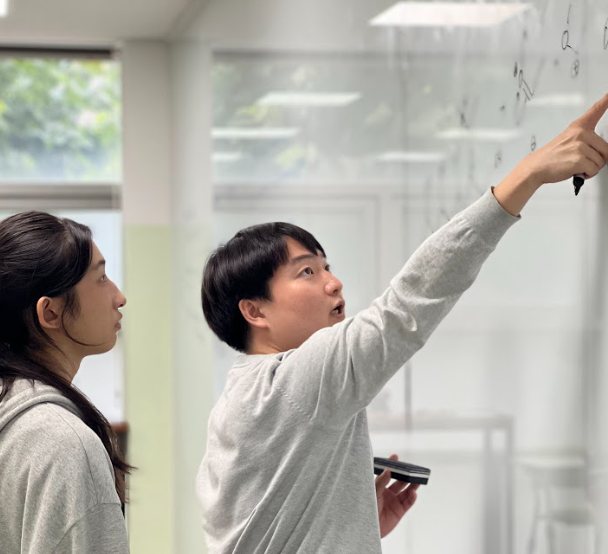
A whiteboard session with Brian Stoltz's chemistry team.
Wearable tech and AI: Nabil Alshurafa's team (Northwestern)
Alshurafa's students study smart devices that analyze body movement and health. Two TAs supported the team.
An XR and human-computer interaction researcher
The first TA, from UC Berkeley's master's program in design engineering, has carried out a range of advanced projects that combine extended reality (XR), user interfaces, computer vision, and design research:
An XR system that corrects exercise form for rehabilitation patients
Vision-based drone navigation using a ZED camera
Avatar interactions driven by gesture recognition
User-experience experiments for VR interfaces
The common thread is solving problems where technology meets user experience. This TA is good at recasting a technical idea as user-centered research and at helping students frame their own questions in interface and HCI work. Project-based research, more than paper writing, is a particular strength, which makes this TA a natural partner for students taking on AI, HCI, or XR topics.
A medical AI engineer and founder
The second TA did medical AI research at the Hong Kong University of Science and Technology (HKUST) and co-founded an AI healthcare startup that took the overall prize at Hong Kong's Techathon+ and was selected for incubation by Hong Kong Science and Technology Parks (HKSTP) and Cyberport. The TA has hands-on experience building technology that industry actually uses:
Large-scale retrieval-augmented generation (RAG) systems
Analysis of unstructured medical data
Deep-learning detection of anomalous signals
Multi-agent AI architectures
That experience means a high school project can go as far as a model that really runs. The TA explains AI architectures in language students can follow, makes a clear case for why a complex model is needed, and works through the details until an idea is something students can build. Students who want to build their research around AI will find this TA an exceptionally dependable guide.
Evolutionary psychology: Max Krasnow's team (Harvard)
The psychology TA is a master's student in psychology at NYU, researching motivation, emotion, and behavior. The TA's grounding in language, cognition, and developmental psychology goes back to undergraduate years at the University of Illinois Urbana-Champaign:
Research on how children acquire language
Analysis of parent–child interaction
Experimental design and data coding
Speech and behavior analysis in ELAN
At NYU, the TA runs carefully designed behavioral experiments on questions such as how mood affects engagement, so the advice students get when designing a psychology project is highly practical. This TA excels at breaking an idea into testable pieces, can help with data processing in R and SPSS, and makes a first behavioral or cognitive experiment manageable for students who have never run one. Students preparing a psychology paper could hardly ask for a better research partner.
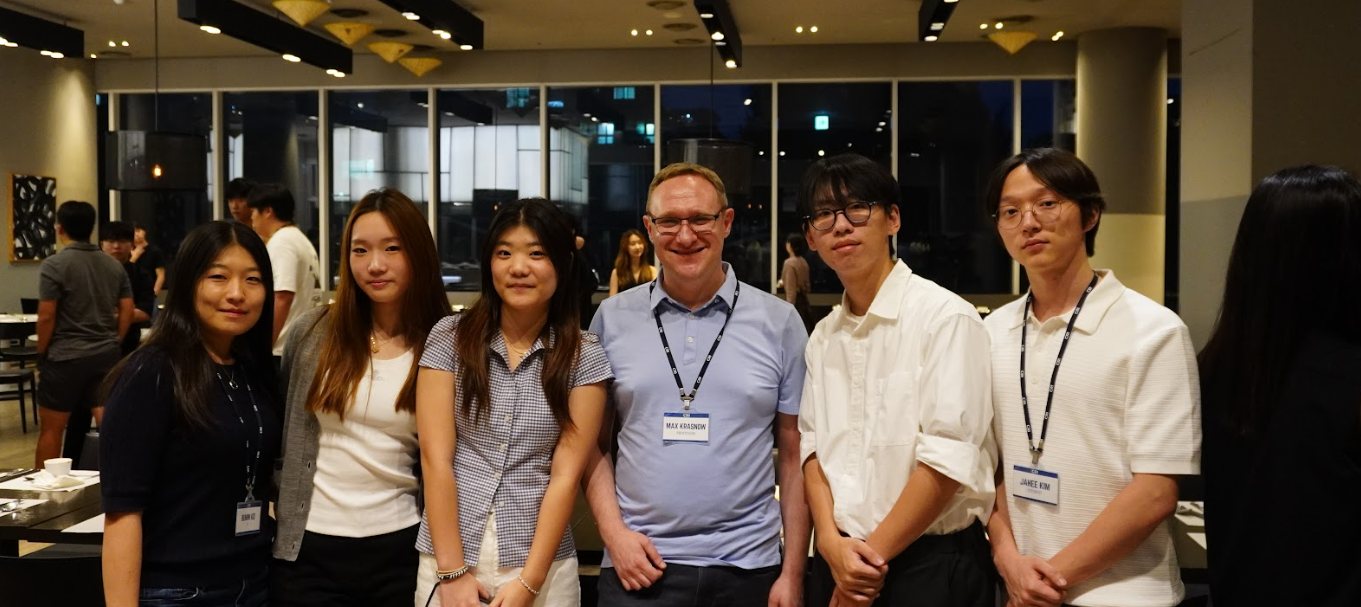
Max Krasnow with members of his evolutionary psychology team.
International law and policy: William Burke-White's team (Penn)
A specialist in policy, security, and humanitarian research
Burke-White's first TA has written two books and numerous papers on international politics, human rights, and security, and has presented research to bodies such as the UN Security Council, the US State Department, South Korea's presidential office, and international NGOs. That background helps students hold an international policy paper to high standards of depth, source reliability, and logical rigor. Having studied computer science alongside public policy at UChicago, the TA can also connect policy research with machine learning and data analysis. In practice, the TA:
Shows exactly how to write a paper the way a strong policy report is written
Helps design studies that draw on both quantitative and qualitative data
Gives feedback that compresses an argument and sharpens it
That combination makes this TA an outstanding mentor for students researching international politics, law, human rights, or governance.
An international education researcher and former Fulbright ETA
The second TA studies international education and the mobility of East Asian international students at Seoul National University's Graduate School of International Studies, and ran education programs at a Korean elementary school as a Fulbright English Teaching Assistant (ETA). With firsthand experience of schooling in the US, Korea, and China, and a record of planning and running international education programs, this TA gives students well-grounded advice when they choose a topic in education or the social sciences. Expect patient help designing qualitative research, from interviews to coding, a firm hand with the logic of social-science writing, and plain explanations of complex ideas in education, international mobility, and policy. This TA is at their best with students pursuing international education, policy, or cultural studies.
Film: James Savoca's team (USC)
Jael holds an MFA from Emerson College and specializes in screenwriting and directing. She has also worked in industry, producing broadcast programs at Shanghai Media Group in China. A short film she directed was selected for international festival programs, including Focus on China at the Venice International Film Festival, and she brings expertise in advertising and brand video as well. That range lets her guide students through the full arc of a film: story concept, script, visual composition, and the structure of the edit.
Jael is skilled at turning an abstract idea into narrative structure and at explaining visual language, shot composition, and a director's intent. She can supervise written research on the arts as well as creative, practice-based projects, which makes her a strong mentor for students working on scripts, video, or film.
Philosophy of education: Liam Gearon's team (Oxford)
The education TA is a PhD student in education at Yonsei University, holds a master's in educational psychology from the Chinese University of Hong Kong, and has worked on many international education policy research projects. That work has meant handling social-science questions with precision:
Comparative policy analysis
Qualitative coding in NVivo
Writing grounded in educational psychology
Research on multiculturalism, migration, and educational inequality
Having coached many international students on how to structure essays and papers, the TA is especially good at making writing logically clear. Students can expect concepts and theories re-explained at their level, a clean introduction–theory–discussion structure, and experienced guidance on qualitative research design. For a paper in education, philosophy, or the social sciences, this TA is an ideal partner.
Entrepreneurship and innovation: Kit Hickey's team (MIT Sloan)
VA7 is the co-founder and CEO of the AI startup Metana AI and has carried out AI transformation projects for large companies such as Hilton. The rest of VA7's background is unusually broad:
Winning a hackathon at ETHDenver
Building a Web3 knowledge-network project
Hands-on work in data engineering, AI modeling, RAG, and RLHF
A habit of reading social problems and markets from a policy perspective
With students, VA7 focuses on what it takes to make an idea viable as a business, gives structure to data-driven market analysis, product strategy, and UX flows, and is especially strong on business plans and pitch decks: a good match for research in entrepreneurship and data-driven innovation.
Research partners, not assistants
CRI's TAs are not there simply to help with assignments. They bring deep research experience in their fields and practical skills built in real projects, institutions, and companies, and they draw on both to design each student's research together with the student. When a professor's expertise meets a TA's feel for the work on the ground, students can go further than high school research usually goes. The point is not hard study for its own sake but the pleasure of chasing a question you genuinely care about.
The TAs CRI selected for its 2025 Winter Online Research Program were held to the same standards as the mentors above. They were chosen for:
Research experience at leading universities around the world
A strong command of papers, experiments, and data analysis
Communication that works for students
The ability to keep research moving smoothly between professor and student
In the summer Seoul Research Program, the professor–TA partnership is built into the schedule, with 20 TA hours alongside 30 hours of teaching by faculty. To see how the summer cohorts are organized, explore the Seoul and Global Research Programs.