How can the world reach net zero faster? S.'s answer was built on rewards, meaning incentives for moving faster, and it appeared on the blog of a University of Pennsylvania policy center in a post co-written with Penn law professor William Burke-White. The work began in Seoul in the summer of 2024, when S. wrote a paper on closing the climate finance gap in Burke-White's class. The same research later became the backbone of S.'s application to Stanford University, where S. was admitted.
A law professor's class in Seoul
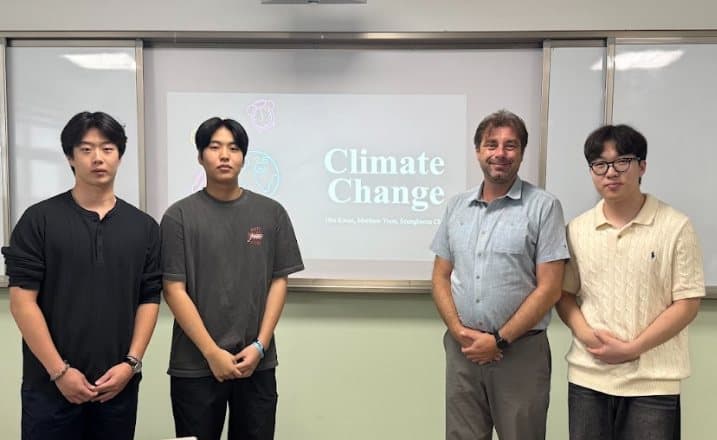
S. took part in the 2024 Seoul Research Program, CRI's summer program in which visiting faculty from US and UK universities teach small groups in person. S.'s professor was William Burke-White of the University of Pennsylvania Carey Law School, founder and inaugural director of Penn's Perry World House and a former member of the State Department's Policy Planning Staff. His work spans international law, global governance, and climate change law. In class, he asks students to learn how to build an argument rather than memorize information, and he follows each student's reasoning and writing closely.
A paper on the climate finance gap
S.'s project grew out of a conviction that young people can contribute to the global debate on climate policy. The subject S. settled on was climate finance and the way international net-zero policy is structured. The result was a paper titled "Leveraging Public Finance to De-Risk Private Investments: Legal Mechanisms to Close the Climate Finance Gap."
The title names both the problem and the proposed response. The problem is the gap between the money climate action requires and the money actually available for it. The response is legal: mechanisms through which public finance takes on part of the risk that keeps private investors away.
Staying on as a research assistant
The paper was not the end of S.'s work with Burke-White. After the program, S. was selected as one of CRI's Research Assistants (RAs), a role that kept the exchange with the professor going.
In that role, S. took on the question of how to speed the move to carbon neutrality and built an answer around rewards, or incentives, for getting there sooner. That answer became a climate-policy post S. co-authored with Burke-White for the official blog of Penn's Kleinman Center for Energy Policy, putting S.'s name beside the professor's on a Penn website.