Paper-writing guide, part 7: proofreading, the final design step
Proofreading is more than fixing typos. Learn how to get useful feedback, restructure a draft and check figures, results, sentences, references and tone before you submit.
The draft is finally done. The argument holds together, the figures are ready and the references are in order. So is the paper finished? Not yet. A first draft is not the end of writing; it is the start of the blueprint.
Proofreading, the last stage of writing a paper, is much more than hunting for typos. It is a design process: you check the structure and logic once more and refine the text until it reaches the reader clearly. This is where a well-written paper becomes an excellent one. The final part of CRI's seven-part paper-writing guide shows how, with checklists you can run on your own manuscript.
Why proofreading matters
Most journals screen submissions before peer review and reject papers with formatting errors or illogical writing at that stage. Even strong research can stop being reviewed simply because the writing is a struggle to read.
Timing matters too. Review, revision and resubmission usually take one to six months, so the polish of your first submission shapes the whole timeline. Proofreading is not just fixing what's wrong. It is your final responsibility to make the paper something a first-time reader can trust.
Show your draft to different readers
You write a paper alone, but you can't proofread it alone. Reread your own sentences enough times and you stop seeing both the typos and the leaps in logic.
Your advisor's review comes first, and one round is not enough. Revise, send it back, revise again: it takes at least two or three rounds before a paper becomes genuinely readable.
Just as important is a classmate or friend who doesn't know the topic. Because they aren't experts, they quickly spot jargon you never explained and places where the logic jumps. They ask the questions a real reader would ask, and their comments can be even more practical than a professor's. A paper isn't written only for the people evaluating it; a good one persuades a wider audience.
A few habits make feedback more useful:
For your advisor, send one package: the draft, a short list of the key questions you want answered, the figure files and the references.
For peers, ask for comments on two things: what they didn't understand and what seemed illogical.
Have a question you want to investigate?
Explore our faculty-guided programs, or tell admissions what you are curious about.
Rotate your readers. Instead of showing the same person every version, have different people review the draft at different stages.
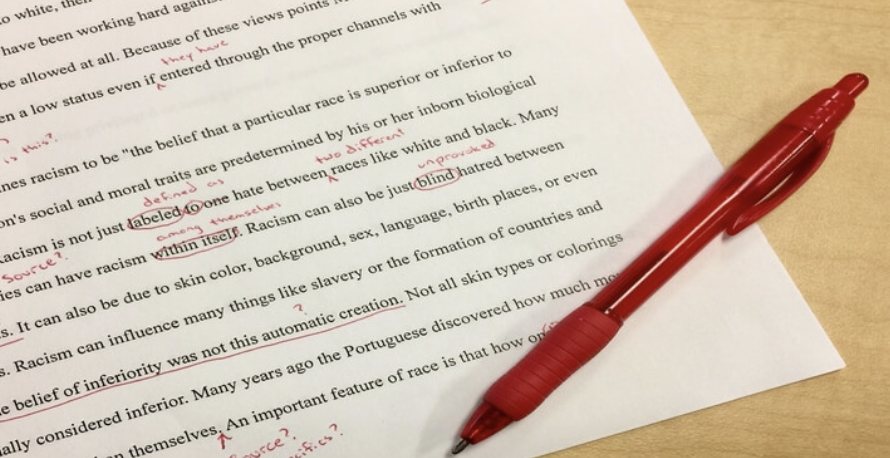
A second reader catches what the writer has stopped seeing, down to a margin note asking for a source.
Don't be afraid to start over
Proofreading brings a familiar temptation: "If I just polish this one sentence, it'll be fine." But if a passage still reads awkwardly after several rounds of edits, rewriting it from scratch is often faster than patching it. A first draft records your thinking; it was not shaped for a reader.
Your own sentences always feel easy, because you already know the background behind them. A first-time reader doesn't, and what sounds natural in your head can look on the page like a series of gaps and jumps. At that point, re-examining the logical flow matters more than fixing individual sentences. Before polishing line by line, look at the skeleton of the whole piece:
Does this paragraph have to be here?
Where is the information the reader needs first?
Would the logic be clearer if the conclusion came earlier?
Good structure keeps readers from getting lost. Here is a quick test: write the topic of each paragraph in a single line, then read only those lines. The logical flow of the whole paper appears at a glance, and if it feels off, tearing up the structure is a perfectly good strategy.
Say deep things in plain words
Many students assume a paper is supposed to be hard to read. In fact, a good paper explains complex ideas simply. Your reader is not your advisor; picture a student at your own level, or someone new to the field.
Academic writing demands accuracy and depth, but it doesn't need to wrap them in difficult words and tangled sentences. When two options mean the same thing, choose the shorter one:
Instead of
Write
utilize
use
demonstrate
show
in order to
to
The longer the sentence, the faster the reader's attention fades. Simpler wording doesn't mean simpler content, though. Explaining a complex idea plainly is proof that you understand it. Three techniques help:
Define each concept with an example.
Link your reasoning with connectives such as then, because and however.
Restate numbers and data in words.
Never assume readers will "obviously" know something; check every expression against their level. Convoluted prose can be a sign that the thinking behind it isn't sorted out yet. Write simply, precisely and with depth.
Figure checklist
A figure is not decoration. It condenses the core of your argument and is key evidence for the reader, so no detail is too small. Before you submit, check the basics:
Scale bars, color bars and units are all there. Without a scale bar, readers can't interpret an image or graph. If you use a colormap, include a color bar and legend. Always state units of measurement (cm, nm, sec and so on).
Every abbreviation is defined in the text or caption. For example, if Fig. 2b shows an "ROI," explain that it means "region of interest," the area targeted in the image analysis.
The text calls out and explains each figure. A figure is not a puzzle for readers to solve alone. Guide them: "The pattern observed in Fig. 1…" or "Fig. 2a shows condition X, and 2b shows condition Y…"
Labels are consistent. Choose one style for subfigures, "Fig. 1a" or "(a)," and keep it. Notation that shifts between caption, text and figure confuses readers. Use "Fig." for one figure and "Figs." for more: "Figs. 2a and 2b show…"
A figure error spotted in review can leave the impression that the whole paper was put together carelessly. One small slip can undermine the credibility of everything else.
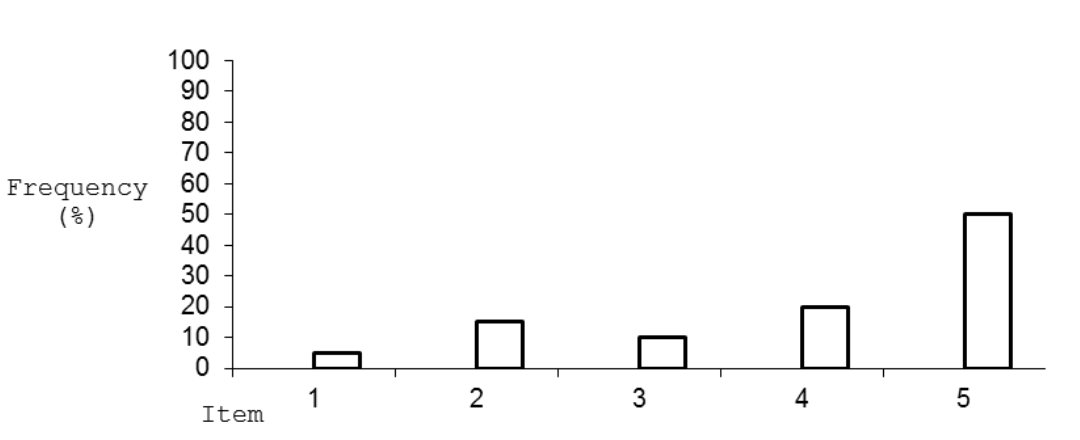
The y-axis states its unit, but only a caption or the text can tell readers what items 1 to 5 are.
Results and discussion checklist
Showing your results is not enough; you are also responsible for interpreting them. These sections are not a place to list data. They must explain, logically and persuasively, what you found, why it matters and what it could mean. When proofreading them, focus on three points:
Claims and possibilities are clearly separated. Match your wording to whether a result is statistically significant or possibly a one-off. Definitive: "This result demonstrates…" Tentative: "This may suggest…" or "A possible explanation is…" Presenting an uncertain result as fact costs you credibility.
The order works for the reader. Results should follow both the sequence of experiments and the logic of the argument, graphs should appear in the order the text discusses them, and nothing should be repeated.
Every technique gets a citation and a brief explanation. This applies to any specialized statistical analysis, computational model or instrument, for example: "We performed two-way ANOVA (see Smith et al., 2021) to analyze the group differences."
Resist the thought "everyone knows this, so I can leave it out." Skipping what seems obvious to you can leave a reviewer struggling to follow.
Sentence-level checklist
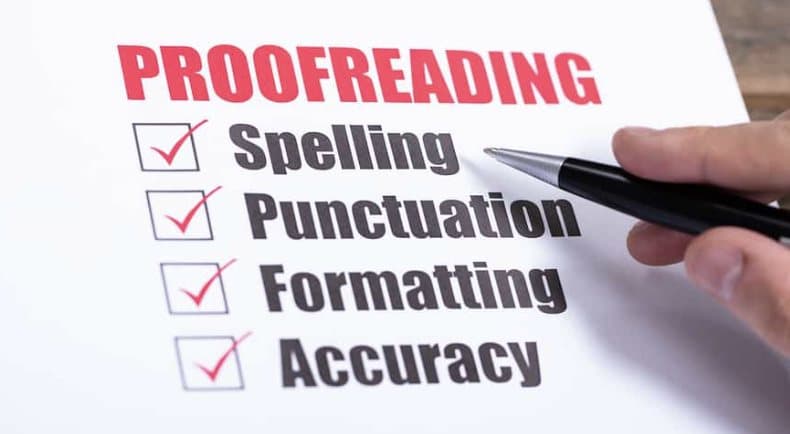
A paper isn't judged on its results alone. Small grammar errors, undefined abbreviations and unit mistakes, repeated often enough, drag down both credibility and clarity. Check these points:
Abbreviations are defined at first use. Spell out the full term the first time: "Scanning Electron Microscopy (SEM)." Abbreviate concepts that appear three or more times; an abbreviation you rarely use makes the text harder to follow.
Numbers and units are spaced correctly. Put a space between a number and its unit: "10 mL," "25 °C" (not "25°C"). Percentages and angles are the usual exceptions and attach directly: "15% increase," "45° angle."
No sentence starts with a symbol or abbreviation. Opening with "e.g.," "&" or a symbol reads as informal and awkward, so "& the results show…" is out. Start with an ordinary word.
Hyphens follow the adjective rule. Hyphenate a compound that works as an adjective ("x-ray diffraction analysis") but not one that works as a noun ("The sample was exposed to x rays."). Writers slip on this often, so keep your usage consistent.
Informal expressions are gone. A paper calls for objectivity, so replace casual wording:
Informal
Use instead
kinda
somewhat / rather
~10
approximately 10
ain't
is not / are not
Set aside the idea that you can write the way you talk. A paper is an argument, and precise, formal language is what persuades.
Reference list checklist
Automated tools aren't perfect, so the final check falls to you. The reference list backs up your writing and is evidence that it can be trusted. Yet many students slip at this last step, assuming EndNote will take care of it.
Citation numbers match, and nothing is listed twice. A source cited as [13] in the text is often missing from the list, or [13] and [22] turn out to be the same paper. The numbering easily falls out of sync when you delete, move or add citations mid-draft. Tools like EndNote help a great deal, but in the end you have to check every line by eye.
No information is missing. A journal may return a paper whose references lack the issue number, page range or year of publication; a DOI is recommended too. Conference papers, preprints and reports are formatted differently from journal articles, so check their fields separately.
You haven't trusted the software blindly. If Google Scholar holds incorrect bibliographic data, EndNote imports it as is, producing authors in the wrong order or inconsistent capitalization in titles.
The rule: EndNote for the first pass, a human for the final review.
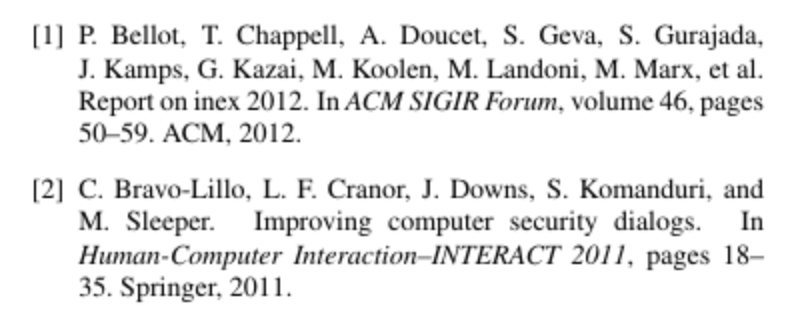
Automated tools can pass along slips such as the lowercase 'inex' (for INEX) in the first entry, so read every line yourself.
Tone: point out limits, don't attack
A paper proves a claim; it is not a platform for criticizing anyone. One of the hardest parts of academic writing is how to critique: pointing out the limits of earlier studies, or pressing your own argument, can easily read as an emotional attack. Checking tone is part of proofreading.
Avoid sentences like these:
"This study is meaningless."
"The authors completely misunderstood the concept."
"This method is seriously flawed."
To a reviewer, they sound unprofessional and emotional. Courtesy and objectivity are the baseline in academia, so ground your criticism in data and state it neutrally:
"This study does not account for X, which may limit its applicability to Y."
"An alternative explanation for this phenomenon could be Z."
"The authors assume A, but recent studies suggest that B may also be relevant."
The point of criticism is not to cut others down but to show why your research is needed. Neutral vocabulary conveys expertise and respect at the same time, instead of leaving readers to guess at your tone:
Aggressive
Neutral alternative
wrong
questionable, debatable
flawed
limited, constrained
fail to
did not address, did not consider
meaningless
inconclusive, lacking support
Present your own claims with the same restraint. Rather than "Our findings clearly prove…", write "Our findings suggest…" or "These results may indicate…" When you do want to sound confident, back it up with numbers or statistical evidence.
Keep a log of your recurring mistakes
The real purpose of proofreading is to get to know your own writing. Everyone repeats the same kinds of mistakes, and they don't vanish in a day or two, so the key is to recognize and manage your own patterns. These come up again and again:
Missing prepositions ("explain to the reader")
Article errors (a, an, the)
Subject-verb agreement ("data is" should be "data are")
Uncountable nouns made plural ("informations," "researches")
Abbreviations such as DNA or AI never spelled out at first use
Mixed-up tenses (past, present, present perfect)
Write each one down as it appears. With every paper you revise, your personal checklist gets sharper.
In a sense, your mistake patterns are your style. Everyone has language habits: some writers circle back over the same reasoning, some drift into abstraction, and some build sentences where the subject and verb end up far apart. Unless you notice these habits yourself, you will get the same comments every time. Start your own checklist with items like these:
Preposition and article errors
Abbreviations defined
Sentence length: how many verbs are in one sentence?
Hyphens, dashes and semicolons used consistently
Figure and table numbers match the text
Reference formatting errors
Let go of the idea of getting it perfect in one draft. What matters is training yourself to make fewer mistakes. Proofreading is less about correcting sentences than about looking honestly at how you write: logging your errors, finding the patterns and writing at least one line more clearly next time. That is the habit of a good researcher.
The complete series
This is the last of seven parts in CRI's paper-writing guide:
Why write a research paper at all?
Decide what you'll say before you decide how to start
Figures are the face of your paper
Writing results and discussion that work
When and how to write the introduction and abstract
Finding, citing and managing your sources
Proofreading, the final design step (this part)
Every part is on the CRI blog, along with a separate guide to editing a manuscript and matching a journal's style before submission.
If you'd like to take a paper of your own through rounds of revision like these, the 1-on-1 Advanced Research Program pairs you with a faculty mentor for an individually arranged project. You write the manuscript yourself in English, and CRI supports it through journal submission.