Why can a worm regrow its body? Stem cell research in a free online atlas
A planarian worm can rebuild its body from a small piece. Follow one of its stem cell genes, piwi-1, from worm to human in free public databases.
"I broke my arm. It took months to heal." Anyone who has spent weeks in a cast knows that slow wait. Your arm did heal, though, and the bone joined back together. But your body can't grow back a whole arm once it's gone. A small flatworm called a planarian can do something close to that. Remove its head, its tail or nearly any other part, and it grows the missing piece back.
So why can a worm regrow its body, and we can't? Biologists have studied that for more than a century, and some of their data is now free to explore on a laptop.
Cut a planarian apart and small pieces regrow
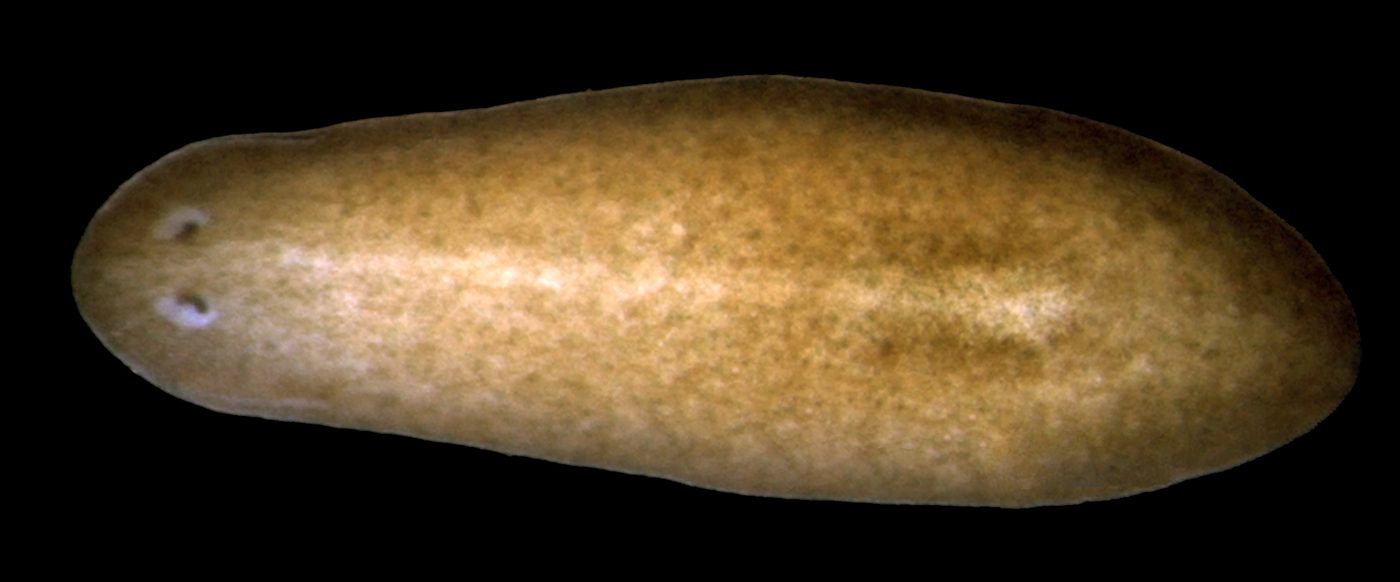
Planarians are soft, flat-bodied worms. The species in the studies below, Schmidtea mediterranea, lives in fresh water around the Mediterranean. In the late 1800s, the American scientist Thomas Hunt Morgan found that a piece as small as 1/279th of a planarian could grow into a whole new worm.
Schmidtea mediterranea, the planarian species behind the studies described here. Photo: Alejandro Sánchez Alvarado, CC BY-SA 2.5, via Wikimedia Commons
The worm's trick is a kind of stem cell called the neoblast. A stem cell can divide and turn into other types of cells. According to the U.S. National Institute of General Medical Sciences (NIGMS), neoblasts make up 20 to 30 percent of a planarian's body. They're spread throughout the body, so a cut in most places leaves some behind to rebuild what was lost.
Regrowth depends on these cells. When lab worms get a dose of radiation that kills their dividing cells, they can no longer regenerate. So the popular line "every piece grows into a new worm" goes too far. A piece needs living neoblasts in it.
We have stem cells too, but ours are specialists. As the Whitehead Institute explains, humans have blood stem cells in the bone marrow, skin stem cells and gut stem cells, each renewing its own tissue. In humans, only embryonic stem cells and germ cells (the cells that become eggs and sperm) are pluripotent, meaning able to make every cell type in the body. The planarian keeps adult cells that can do this. That's one big difference, though not the whole answer to why we can't regrow an arm.
Have a question you want to investigate?
Explore our faculty-guided programs, or tell admissions what you are curious about.
How regeneration researchers find the cells and read their genes
In the lab, regeneration research usually runs in two steps. First, find the cells that do the rebuilding. Then, read which genes are switched on inside them.
To find the cells, researchers use marker genes. A marker is a gene active in one cell type and not in most others, so staining for it makes those cells stand out under a microscope. For neoblasts, the standard marker is piwi-1, which older papers call smedwi-1. Its protein belongs to the PIWI family, a group defined by a fruit fly protein called PIWI.
To read the genes, labs use single-cell RNA sequencing, which shows the active genes in each cell. In 2018, Christopher Fincher, Peter Reddien and colleagues at the Whitehead Institute and MIT published data on 66,783 planarian cells in Science, covering essentially every cell type in the worm. They made the atlas public as a website, Planarian Digiworm.
A third tool, RNA interference (RNAi), shuts down one gene at a time to test whether it's needed. Shutting down smedwi-2, a gene related to piwi-1, blocks regeneration even though the neoblasts are still present (Reddien and colleagues, 2005).
One stem cell rebuilt a worm: the 2011 study
A direct test of what a single neoblast can do came in 2011, from Daniel Wagner, Irving Wang and Peter Reddien at the Whitehead Institute, published in Science.
The team gave host worms a dose of radiation strong enough to kill their own neoblasts. Such worms can't regenerate, and in this study they died after about six weeks. Into each host, they injected a single cell from another planarian strain. They sorted the donor's cells by size and shape and picked ones that looked like clonogenic neoblasts (cNeoblasts), a type that can divide into a large colony.
In 7 of 130 transplanted worms, that one cell took over. These worms lived past seven weeks, grew new tissue where their bodies had been breaking down, regenerated eyespots and a feeding tube, and were eating again by eight weeks. The team grew three of the rescued worms into new lines and checked their DNA. It matched the donor strain, not the host: the descendants of one cell had replaced the host's tissues. The authors concluded that adult pluripotent stem cells, spread throughout the body, are the source of planarian regeneration.
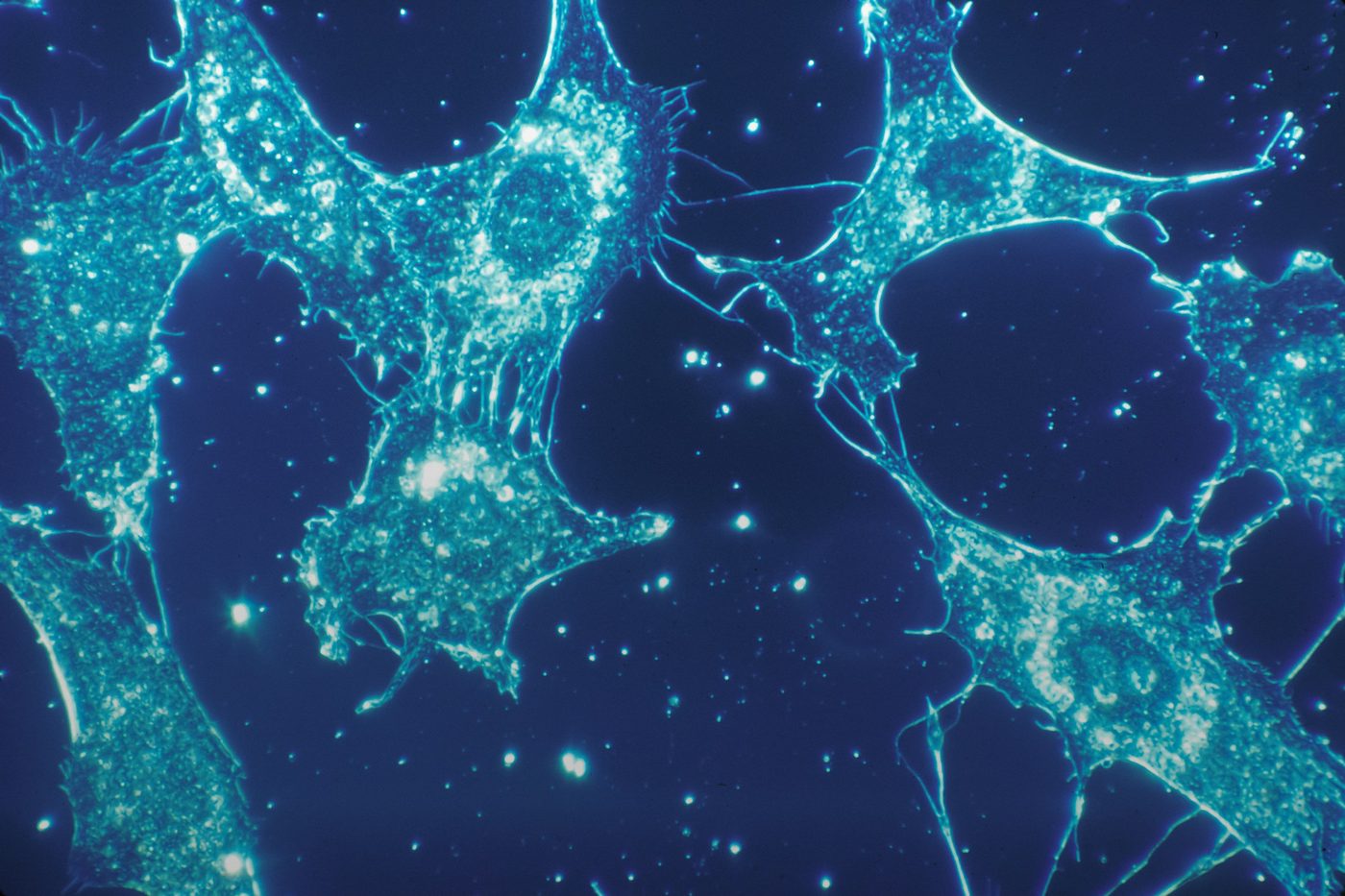
The 2011 team picked donor cells about 10 micrometers (0.01 mm) across, far too small to see without a microscope. This stock image shows other cells, not planarian neoblasts.
The limits: the rescue worked in only about 5 percent of transplanted worms, and it shows what one planarian cell can do inside a planarian, not what human cells could do.
Follow piwi-1 from worm to human, no lab needed
You don't need worms or a lab for a first project. This one uses only public data, so there's nobody to recruit and no animals to keep. Plan on two to four weeks of after-school time.
Step 1. Pick one gene: piwi-1 (about 1 hour). Read the Whitehead Institute news story on the 2011 study, then the abstract of the 2005 paper that identified smedwi-1 and smedwi-2. Write down every name the gene goes by. In the protein database UniProt, the worm protein is entry Q2Q5Y9, "Piwi-like protein 1", also listed as SMEDWI-1.
Step 2. Open the free planarian cell atlas (1 to 2 hours). Go to Planarian Digiworm and open the Atlas tab. Type piwi into the search box and press Search. One result is the contig dd_Smed_v4_659_0_1, labeled "PIWI-like protein 1 (wi-1)". A contig is a pieced-together stretch of gene sequence; here it stands for the gene. Click that row, and the site draws a map in which each dot is one cell, colored from blue (gene barely active) to red (strongly active).
Step 3. See which cells use it (2 to 3 hours). Compare the colored map with the numbered cluster map beneath it. The site also lists where the gene is enriched: for piwi-1, the main clustering names only Neoblast clusters. A table of genes enriched in each cluster puts piwi-1 near the top of the Neoblast list. Then click "PIWI-like protein 2 (wi-2)", the smedwi-2 gene, and check whether its map matches. Save screenshots and record cluster names in a spreadsheet.
Every step of this project runs in a web browser on free public databases.
Step 4. Find its human match (1 to 2 hours). Open NCBI BLAST, the free sequence-comparison tool of the U.S. National Center for Biotechnology Information. Choose Protein BLAST, enter Q2Q5Y9 in the query box, set the organism to Homo sapiens, and run it. BLAST lists human proteins whose sequence resembles the worm protein, each with an E-value: the smaller it is, the less likely the match is due to chance. Look for human PIWI proteins among the hits. UniProt puts the worm protein and human PIWIL1 in the same Piwi subfamily, and Digiworm's notes for this gene name PIWIL1 as its closest human match, so you can check your result. Then look up each hit in NCBI Gene. For human PIWIL1, the summary says the protein may help germline stem cells (which make eggs and sperm) and blood-forming stem cells renew themselves.
Be honest about what this step shows. A strong sequence match suggests two genes share an evolutionary origin. It doesn't mean the human gene does the same job in the same kind of cell.
The finished project. A short paper of four to six pages, or a one-page poster: the atlas maps for piwi-1 and wi-2 as Figure 1 (credit Fincher and colleagues, 2018), a table of the top human BLAST matches with their E-values as Table 1, and a discussion of what the comparison can and can't tell you.
Regeneration questions a browser can answer
The workable versions are sized for Digiworm, BLAST and NCBI Gene:
Too big
Workable
Why can't humans regrow an arm?
In the Digiworm atlas, which cell clusters show piwi-1 activity, and does wi-2 show the same pattern?
Could planarian genes help people heal?
Which human proteins are the closest BLAST matches to planarian PIWI-1, and what does NCBI Gene report about each one?
What lets planarians regenerate?
Of the top 25 genes in the atlas's Neoblast list, which ones does the atlas match to a human gene, and what does NCBI Gene say those human genes do?
The left column would keep a lab busy for years. Each question on the right fits free tools and a few weeks.
Mapping piwi-1 in the atlas gives you one kind of paper. A literature review or a research proposal makes an equally complete one. A literature review sets published studies side by side. One question: how have researchers tested which neoblasts can rebuild a whole worm (radiation, single-cell transplants, cell sorting, single-cell sequencing), and where do their findings disagree? Molinaro and Pearson's 2018 paper, in the Sources, is such a review. For the studies themselves, use PubMed and Google Scholar. A research proposal can plan an experiment that belongs in a university lab: say, whether zebrafish, which regrow lost fin tissue, switch on their PIWI genes in the regrowing fin. It sets out the method (trim the tail fins of anesthetized fish, then stain the regrowing tissue for PIWI gene activity 3, 7 and 14 days later), how many fish you'd sample at each point, and the approval you'd need: zebrafish are vertebrates, so a university animal care committee must approve the plan first.
Your broken arm was the question. Now research it.
At CRI, high school students work with university professors and teaching assistants on a question of their own and write their own paper, which may take the form of original research, a literature review or a research proposal. For this subject, Aziz Aboobaker, Professor of Comparative and Functional Genomics at the University of Oxford, leads The Secrets of Immortality: Stem Cells, Gene Networks, and the Science of Regeneration. It is part of CRI's Winter Online Research Program, which meets online from December 19 to 30, 2026. Up to 5 students can join, and applications close December 15.
Sources
Beans, C. (2015). Interview with a worm: We're not so different. National Institute of General Medical Sciences, Feedback Loop Blog. link
Rura, N. G. (2011). Pluripotent adult stem cells power planarian regeneration. Whitehead Institute for Biomedical Research. link
Wagner, D. E., Wang, I. E., & Reddien, P. W. (2011). Clonogenic neoblasts are pluripotent adult stem cells that underlie planarian regeneration. Science, 332(6031), 811-816. link
Davis, N. (2018). New single-cell database to propel biological studies. Whitehead Institute for Biomedical Research. link
Fincher, C. T., Wurtzel, O., de Hoog, T., Kravarik, K. M., & Reddien, P. W. (2018). Cell type transcriptome atlas for the planarian Schmidtea mediterranea. Science, 360(6391), eaaq1736. link
Reddien Lab, Whitehead Institute. Planarian Digiworm (single-cell atlas website). link
Reddien, P. W., Oviedo, N. J., Jennings, J. R., Jenkin, J. C., & Sánchez Alvarado, A. (2005). SMEDWI-2 is a PIWI-like protein that regulates planarian stem cells. Science, 310(5752), 1327-1330. link
Molinaro, A. M., & Pearson, B. J. (2018). Myths vs. FACS: What do we know about planarian stem cell lineages? International Journal of Developmental Biology, 62(6-7-8), 527-535. link
UniProt. Q2Q5Y9: Piwi-like protein 1 (SMEDWI-1), Schmidtea mediterranea. link
National Center for Biotechnology Information. BLAST (Basic Local Alignment Search Tool). link
UniProt. Q96J94: Piwi-like protein 1 (PIWIL1), Homo sapiens. link
National Center for Biotechnology Information. Gene: PIWIL1, piwi like RNA-mediated gene silencing 1 (Homo sapiens). link