Why did my antibiotics stop working? A high school research idea
MRSA makes an extra protein that penicillin-type drugs bind only weakly. See how chemists respond, and dock molecules into that protein with free software.
"My antibiotics stopped working last winter." A course of antibiotics that does nothing is a common story. The fever stays, the cough stays, and a few days later a doctor writes a different prescription. It's easy to file that under bad luck. Chemists file it under a question they have been working on for decades: how do you build a drug that bacteria can't easily beat?
One correction before going further. A pill that did nothing isn't proof that you met a resistant infection. Colds and flu are caused by viruses, and the US Centers for Disease Control and Prevention (CDC) says plainly that antibiotics and antifungals do not work on viruses. A course stopped early, or an illness that was never bacterial, looks identical from the sofa. The research question survives anyway: drug-resistant bacteria are real, and you can start on part of the research this week.
How bacteria outlast a drug that never changes
Antimicrobial resistance, in CDC's wording, happens when germs develop the ability to defeat the drugs designed to kill them. Bacteria divide quickly and their populations carry small genetic differences. When a drug kills almost every cell, a rare survivor can rebuild the whole population in its own image. The bacteria change. The molecule in your pill stays exactly the same.
CDC counts more than 9.3 million drug-resistant infections in the United States each year, and more than 39,000 deaths. A caution on that figure: CDC changed its methods for the latest update of its Antimicrobial Resistance Threats Report, and says the new numbers should not be compared directly with earlier editions.
The clearest example to study is MRSA, short for methicillin-resistant Staphylococcus aureus. Penicillin-type drugs, called beta-lactams, work by blocking the enzymes that stitch a bacterial cell wall together, and those enzymes are known as penicillin-binding proteins. S. aureus strains that carry the mecA gene make an extra one called PBP2a. Lim and Strynadka, who published its crystal structure in 2002, spell out why: PBP2a has low affinity for beta-lactams, so it keeps building the cell wall at drug concentrations that shut down the normal penicillin-binding proteins.
Have a question you want to investigate?
Explore our faculty-guided programs, or tell admissions what you are curious about.
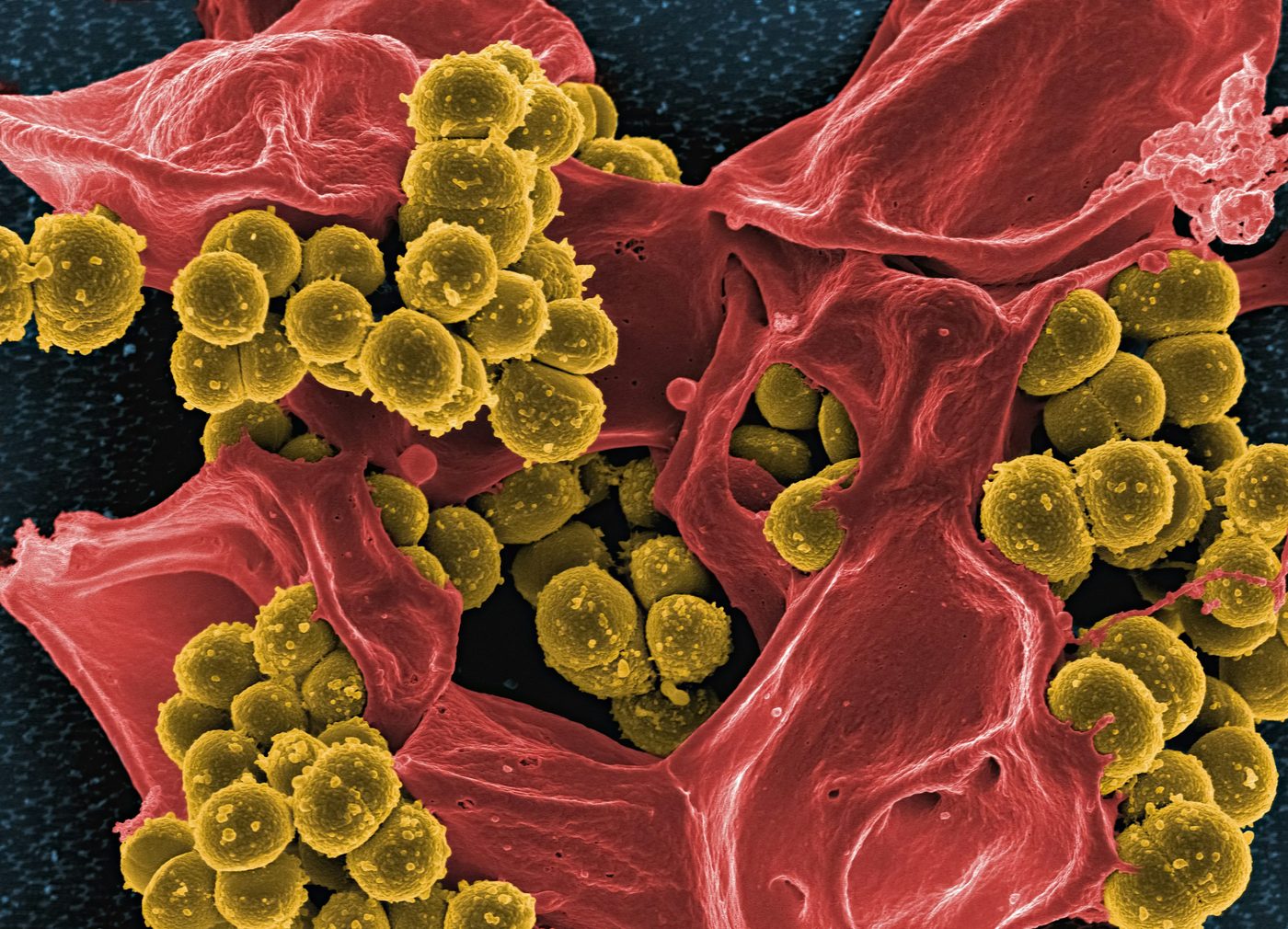
MRSA under an electron microscope, colorized. The yellow spheres are the bacteria named in the method below; the red sheets are the remains of a human white blood cell.
Picking a target bacteria cannot easily change
Drug research starts with a choice that sounds simple and isn't: what, exactly, should your molecule grab?
If the answer is a single bacterial protein, the bacteria have an exit. One gene codes for it, and mutations can reshape the pocket the drug was built for until the drug no longer fits. PBP2a is that escape route in finished form, a protein that does the wall-building job while binding the drug weakly, so blocking the usual enzymes is no longer enough.
So you ask a narrower question. Which parts of a bacterium are hard to change without breaking the bacterium? Enzymes have some freedom to shift shape. The building blocks those enzymes work on have less of it, because many enzymes have to recognize them.
What the teixobactin paper actually reported
In 2015, Ling and colleagues published a paper in Nature on a molecule they named teixobactin, found in a screen of uncultured bacteria, the roughly 99% of environmental species that standard methods won't grow. Teixobactin blocks cell wall synthesis by binding a highly conserved part of lipid II, the precursor of peptidoglycan, and lipid III, the precursor of cell wall teichoic acid. It grabs the building blocks, not a protein. In the experiments in that paper, the team did not obtain any mutants of S. aureus or M. tuberculosis resistant to it.
Most environmental bacteria have never been grown in a laboratory. The teixobactin paper calls them an untapped source of new antibiotics.
That result is worth reading precisely, because it's easy to inflate. "We did not obtain any mutants" describes one set of experiments, over a limited time, with particular bacteria and methods. It isn't proof that resistance can never appear. Teixobactin also isn't a medicine you can be prescribed: a search of ClinicalTrials.gov in November 2026 returned no registered studies for it. What the paper gives you is the reasoning, not a finished product. Aim at something the bacterium cannot easily redesign, and resistance gets harder to evolve.
Docking molecules into PBP2a in four steps
You can't screen soil bacteria at home, and you shouldn't try to grow resistant bacteria at school. The computational side of the same field is genuinely open to you, and this version involves no human participants, so no ethics review is needed. (If you later add a survey about antibiotic use, you need your school's approval and consent from everyone you survey, with a parent's consent for anyone under 18. Many science fairs also require an institutional review board, or IRB, to approve the plan before you collect anything, so check your fair's rules first.)
Step 1: pick one target and learn what it does. PBP2a in MRSA is a good first choice because it's well studied. Give this a weekend of reading. You're finished when you can explain in one paragraph, without notes, what the protein does for the bacterium.
Step 2: download its 3D shape. Protein structures are free. The RCSB Protein Data Bank entry 1VQQ holds a soluble form of PBP2a from MRSA strain 27r, solved by X-ray crystallography at 1.80 Å (an ångström is a ten-billionth of a meter) by Lim and Strynadka and released in 2004. Open the coordinate file in UCSF ChimeraX, free for academic, government, nonprofit and personal use. One detail matters: 1VQQ carries no drug, only cadmium and chloride ions, so it won't show you where a beta-lactam sits. Download 1MWT as well, the same protein at 2.45 Å with penicillin G attached, and use it to locate the site. Allow an evening or two.
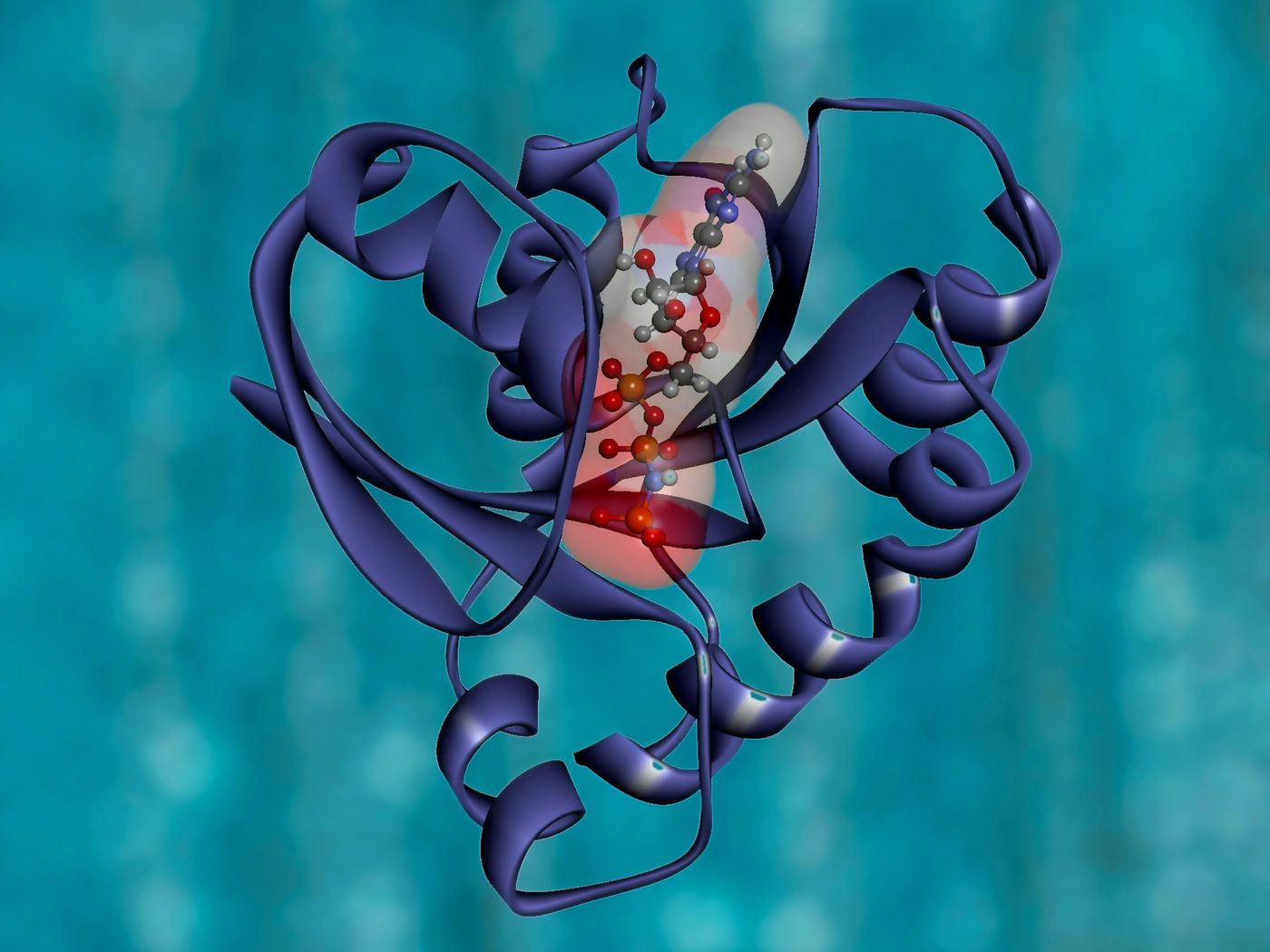
Docking asks whether a small molecule fits a pocket like this one. The protein in this render is not PBP2a; it stands in for the idea.
Step 3: dock molecules into that site.AutoDock Vina is an open-source docking program released under the Apache license. Docking means asking the software to try thousands of positions for a molecule inside a pocket and report the best-scoring fits. Vina won't read your downloaded files as they are: the protein and the molecule both have to be converted to its PDBQT format first, and the Vina documentation walks through that with the free Meeko scripts. Get your small molecules from PubChem, which is free and gives you an SDF file to start from (penicillin G is compound 5904). Center the search box on the site you found in 1MWT. Expect a weekend to install everything and get one clean run. After that, each molecule takes minutes on an ordinary laptop. Note the software versions you used, so your numbers can be reproduced.
Step 4: compare scores with known antibiotics, carefully. A docking score is a prediction, not a measurement, and two limits are worth stating plainly. First, beta-lactams don't simply sit in the pocket. They react with the active-site serine and stay chemically bonded to it, which is why the 1MWT structure is an acyl complex. Vina scores non-covalent fit, so it can't model that reaction. Second, the drug-free and penicillin-bound structures aren't identical, so which one you dock into is part of your method. Your score is a rough measure of shape and fit. Use it to compare molecules against each other under identical settings, and don't read it as how well a drug would work in a patient. Saying so makes your project stronger, not weaker. Budget one to two weeks for the comparison and the writing. The finished product is a short paper or a conference-style poster with a results table and two or three figures.
Two pointers for students in Korea. The same structure files are served from Japan by PDBj. For Korean resistance figures rather than American ones, start with Kor-GLASS, the national surveillance system built to match the WHO one. Its first-year report in Eurosurveillance counted 1.6 bloodstream infections per 10,000 patient-days from methicillin-resistant S. aureus in inpatients, May 2016 to April 2017.
How narrow an antibiotic question should be
The gap between an interesting topic and a project you can finish is usually the width of your question.
Too big
Workable
Can I design an antibiotic bacteria cannot resist?
How do AutoDock Vina scores against PBP2a rank ten published beta-lactams whose activity against MRSA is already reported?
Why does MRSA resist antibiotics?
Does the same molecule score differently against the drug-free structure (1VQQ) and the penicillin-bound structure (1MWT), and by how much?
Find a better drug than penicillin
Do molecules reported in the literature as PBP2a binders score better than a control set of similar-sized molecules with no reported activity?
You can answer each question on the right with free software and a laptop, and each gives you a table somebody else could reproduce. That's what a good docking project delivers: not a cure, but a result with its limits written down.
A strong paper on resistance doesn't have to start with docking, or with new data at all. A literature review works from studies other labs have already published. You could ask how follow-up studies of teixobactin and its synthetic analogues tested for resistance: which bacteria, how many days of repeated exposure, and whether anyone found resistant mutants. Find the papers on PubMed and Google Scholar, then compare their methods sections. A research proposal designs the lab work a school can't safely host. Your docking scores leave the next question open: does a top-scoring molecule actually stop MRSA from growing? A proposal states that question, describes the method (finding the lowest concentration that stops growth, in MRSA and in a methicillin-susceptible strain), lists the compounds and bacterial strains you'd need, and names the biosafety approval a university lab requires before handling MRSA.
Your infection was the question. Now research it.
Students who want to work on this kind of chemistry with a faculty mentor can look at Quantitative Analysis of Biochemistry, taught by Jason Sello, Professor of Pharmaceutical Chemistry at the University of California San Francisco (UCSF). It runs in CRI's Winter Online Research Program: online, December 19 to 30, 2026, with up to 5 students, each writing their own paper, which may report original research, review the literature or propose a new study. Applications close December 15.
Ling, L. L., Schneider, T., Peoples, A. J., et al. (2015). A new antibiotic kills pathogens without detectable resistance. Nature, 517(7535), 455-459. https://www.nature.com/articles/nature14098
Lim, D., and Strynadka, N. C. J. (2002). Structural basis for the beta lactam resistance of PBP2a from methicillin-resistant Staphylococcus aureus. Nature Structural Biology, 9(11), 870-876. https://doi.org/10.1038/nsb858
RCSB Protein Data Bank. Entry 1VQQ: structure of penicillin binding protein 2a from methicillin resistant Staphylococcus aureus strain 27r at 1.80 Å resolution. https://www.rcsb.org/structure/1VQQ
RCSB Protein Data Bank. Entry 1MWT: structure of penicillin G acyl-penicillin binding protein 2a from methicillin resistant Staphylococcus aureus strain 27r at 2.45 Å resolution. https://www.rcsb.org/structure/1MWT